AI adoption is not just a technology problem. It is a human learning problem.
Every organization I know is talking about AI strategy. Which tools should we use? Where should we automate? Which models are safe enough for enterprise use? What productivity gains can we capture? How should we govern usage? What should employees be allowed to do?
These are all important questions.
But I increasingly think we are spending far more time thinking about what artificial intelligence can do than we are thinking about what people need to become in order to work effectively with it.
That may be the bigger problem.
Because implementing AI and adapting to AI are not the same thing.
You can deploy a capable technology without developing capable users. You can give people access to powerful tools without helping them build the judgment, habits, curiosity, confidence, and self-awareness required to use those tools well.
You can have an AI strategy and still fail at AI adoption.
That is why I think organizations, and individuals, need something more.
They need an AI learning strategy.
I Have Been Circling This Question for a While. Over the last several months, I have written a series of articles trying to understand the human side of AI adoption.
The first question I asked was:
How do people remain fully human while AI changes what it means to work? That question became the starting point for what I now call the AI Adoption Learning Frame. From there, I began exploring the individual parts of the problem
In C:\HUMAN\RUN.EXE, I asked:
What part of you should never be outsourced?
That became Anchor.
In Humans Change When AI Enters the Room, I explored how AI can alter confidence, attention, perception, and judgment.
That became Sight.
In AI Doesn’t Reward Knowing, I argued that the most important response to AI may not be mastering today’s tools, but developing the curiosity and learning habits required to keep adapting.
That became Stance.
And in Why Reinvention Is the Most Important Skill in an AI Economy, I explored what happens when technology begins changing not only what we do, but how we understand our own professional identity.
That became Direction.
At first, I thought of these as four separate questions.
I no longer do. I think they are four parts of the same learning problem. Capability Is Not Adoption. This distinction has become increasingly important to me. When organizations talk about AI adoption, they often focus on capability.
Can the model perform the task?
Can it improve efficiency?
Can it generate the content?
Can it make the recommendation?
Can it automate the workflow?
Those are technology questions.
But human adoption introduces a very different set of questions:
Will people trust it too much?
Will they trust it too little?
Will they use it to avoid thinking?
Will they use it to improve thinking?
Will it make them more dependent?
Will it make them more capable?
Will they challenge it when it is wrong?
Will they recognize when it is changing their behavior?
Those outcomes are not determined by the technology alone.
The same AI system can produce very different outcomes depending on the person using it, the environment in which it is used, and the habits being formed around it.
That is why access is not adoption.
Training is not adoption.
Deployment is not adoption.
Adoption requires learning.
We Spend a Lot of Time Teaching People What AI Can Do. This may be the part of the AI conversation I find most incomplete. We teach people how to write better prompts. We teach them which tools to use. We teach them how to summarize documents, generate images, draft emails, analyze data, and automate workflows.
All of that is useful. But I think there is another layer we are underdeveloping. We are not spending nearly enough time helping people understand what AI is changing in them.
How is it affecting their confidence?
Their attention?
Their judgment?
Their curiosity?
Their willingness to struggle with a difficult problem?
Their sense of professional identity?
Their willingness to become a beginner again?
Those are learning questions. And I think they matter just as much as the technology questions.
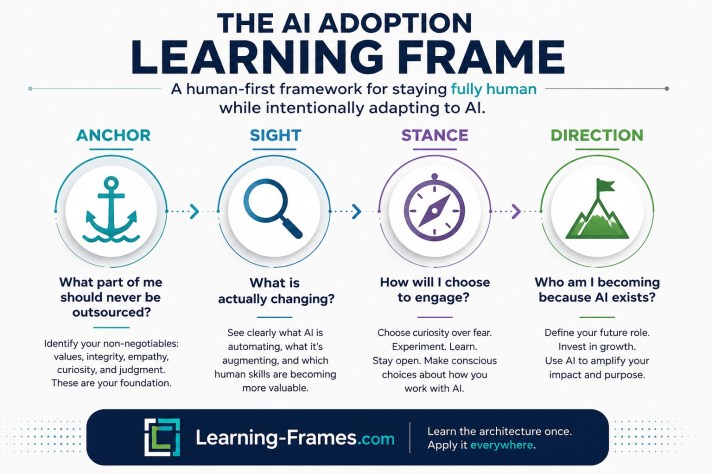
The AI Adoption Learning Frame:
The AI Adoption Learning Frame is my attempt to give those human questions a structure.
It has four parts.
Anchor
What must remain human?
Anchor is about deciding what should not be outsourced simply because technology makes outsourcing possible.
Judgment.
Integrity.
Curiosity.
Responsibility.
Meaning.
Relationships.
The ability to think through something difficult.
Before we decide what AI should do for us, Anchor asks us to decide what we still need to do for ourselves.
Sight
What is actually changing?
Sight is about awareness.
Not only awareness of what the technology can do, but awareness of how the technology is changing the person using it.
In Humans Change When AI Enters the Room, I wrote about research showing that incorrect AI recommendations could influence experienced radiologists away from judgments they had previously made correctly.
The important lesson for me was not simply that AI can be wrong.
It was that humans change when AI enters the room.
Confidence changes.
Attention changes.
Behavior changes.
Sight asks us to notice those changes before they become invisible.
Stance
How will I intentionally engage with AI?
Stance is about choice.
AI is already creating habits in all of us.
Some habits will make us more dependent.
Others will make us more capable.
Some will encourage intellectual laziness.
Others may help us learn faster than ever before.
In AI Doesn’t Reward Knowing, I argued that we may need to stop thinking of AI adoption as a race to know the right tools and instead develop the mindset required to keep learning as those tools change.
Stance is where we choose curiosity over certainty.
Experimentation over resistance.
Learning over performance.
Intentional use over passive adoption.
Direction
Who am I becoming?
Direction is about where all of this leads.
AI is changing jobs.
It is changing roles.
It is changing where value is created.
And in some cases, it is challenging identities people have spent years building.
That is why I argued in Why Reinvention Is the Most Important Skill in an AI Economy that AI does not simply require reskilling.
Sometimes it requires re-identifying.
Direction asks us to move beyond the question:
How do I protect the work I already know how to do?
And toward a different one:
Who am I becoming because AI exists?
The Four Questions Work Together
This is the part of the framework I have come to appreciate most.
These are not four independent ideas.
They depend on each other.
Anchor without Sight can become stubbornness.
If I know what I value but refuse to see what is actually changing, I may simply cling to the past.
Sight without Stance can become awareness without action.
I can recognize what AI is changing and still do nothing intentionally about it.
Stance without Direction can become experimentation without purpose.
I can try every new tool and still have no idea where I am going.
And Direction without Anchor can become chasing.
I can constantly reinvent myself without knowing which parts of me should remain stable.
That is why the sequence matters.

Anchor keeps you from losing yourself.
Sight keeps you from fooling yourself.
Stance keeps you from reacting blindly.
Direction keeps you from standing still.
Together, they create a learning system.
What This Looks Like in Practice
Imagine a hospital introducing AI-assisted clinical decision support.
A traditional AI strategy might focus on:
Accuracy.
Integration.
Compliance.
Workflow.
Training.
Governance.
All of those things matter.
But an AI learning strategy would ask additional questions.
Anchor: What clinical judgment must remain human?
Sight: How is the AI changing clinician confidence, attention, and willingness to disagree?
Stance: When should a clinician trust the recommendation? When should they challenge it? When should they verify it independently?
Direction: As AI takes on more routine cognitive work, what capabilities should clinicians develop next?
Now imagine the same framework applied to a product manager.
Anchor: What thinking do I refuse to outsource?
Sight: What habits is AI changing in how I make decisions?
Stance: How do I want to use AI intentionally?
Direction: What new capabilities should I develop as parts of my current role become easier to automate?
The technology may be the same.
The learning challenge is different.
That is exactly the point. An AI Strategy Asks Where We Can Use AI. An AI learning strategy asks a different question:
How do we help people grow while they use it?
That distinction changes the conversation. Instead of measuring adoption only by usage, we can ask whether people are becoming more capable. Instead of only teaching prompts, we can teach judgment. Instead of only teaching tools, we can develop curiosity. Instead of only automating work, we can intentionally redesign the work humans should continue doing.
Instead of assuming people will adapt, we can help them learn how to adapt. That is the missing layer I keep coming back to. AI Capability Will Keep Advancing. I do not think the pace of AI development is going to slow down enough for any of us to feel permanently caught up.
Today’s model will be replaced. Today’s workflow will change. Today’s AI skill may eventually become invisible inside another product. That means a static AI strategy will always have a shelf life.
A learning strategy is different.
It assumes change.
It assumes uncertainty.
It assumes people will need to become beginners again.
And it builds the capability to respond.
That is why I increasingly believe the organizations that adapt best to AI will not simply be the organizations with the best models, the best vendors, or the most aggressive automation roadmaps.
They will be the organizations that learn how to develop people alongside the technology.
The Next Question:
I have spent the last several months trying to understand whether the AI Adoption Learning Frame can help people remain grounded while adapting to AI.
I think it can.
But that creates a more practical question.
Can the framework actually help someone learn something difficult faster and more effectively?
Not just understand a concept. Not just use a tool. Learn a complex job. Build judgment. Develop confidence. Move from beginner toward competence.
That is the next question I want to explore.
Because if the framework is really a learning system, it should be able to do more than explain disruption. It should help people learn their way through it.
Learning Frames helps people learn their way through disruptive change.
The AI Adoption Learning Frame helps people remain fully human while intentionally adapting to AI.

Learn the architecture once. Apply it everywhere.
Measure Learning by What You Can Do Without AI.


