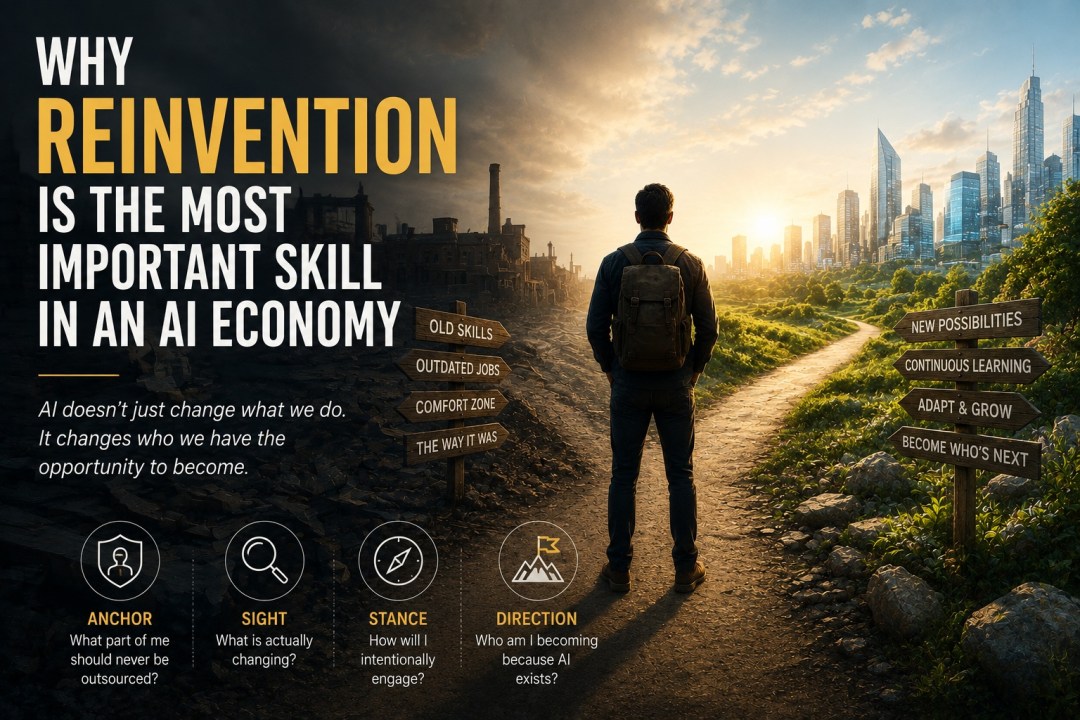
AI doesn’t just change what we do. It changes who we have the opportunity to become.
There is something unsettling about preparing for a future you can’t see.
Most of us were taught a fairly straightforward model for building a career. Learn something valuable. Become good at it. Gain experience. Develop expertise. If you do those things well enough and long enough, your value should increase.
For much of my career, that model worked reasonably well.
I’m not sure it works anymore.
Recently I listened to writer Jason Pargin talk about his own career. What struck me wasn’t his success. It was how many times the path toward that success required him to become someone he hadn’t planned to become.
When Pargin went to college, many of the things that would eventually define his career didn’t exist.
There were no blogs.
No podcasts.
No smartphones.
No social media.
Certainly no TikTok.
How do you prepare for a career built on technologies, platforms, and even job categories that haven’t been invented yet?
You can’t.
At least not in the traditional sense.
What you can do is become someone capable of changing when the world changes.
And I think that may be one of the most important lessons for all of us as artificial intelligence begins reshaping work.
Starting Over Is Becoming Normal
One of the things I appreciated about Pargin’s story was that reinvention didn’t happen once.
It happened repeatedly.
He watched an industry he had prepared to enter change around him. He had to learn skills he hadn’t expected to need. He blogged for free. He learned to network. He accumulated debt. Later, even after becoming successful, new platforms kept appearing that required him to adapt again.
Photography.
Podcasting.
Video.
TikTok.
Some of those things he didn’t particularly want to do.
But the world wasn’t asking whether he wanted it to change.
It was simply changing.
I think we’re entering a period when that experience becomes much more common.
AI isn’t going to affect every profession equally or all at once. Some jobs will disappear. Others will change. New jobs will emerge. Most of us will probably experience something less dramatic but more persistent: pieces of what we do will continually move between human and machine.
A task that made you valuable five years ago may become automated.
A skill you’ve spent years developing may become easier for everyone to access.
An entirely new capability may suddenly become valuable.
That can feel threatening because work is rarely just work.
Work becomes part of identity.
We don’t simply say, “I perform product management.”
We say, “I’m a product manager.”
I’m a writer.
I’m a teacher.
I’m a developer.
I’m a designer.
I’m a physician.
I’m an analyst.
We attach identity to competence. We spend years becoming something, and then naturally expect that something to remain valuable.
But what happens when the world changes the value of what we became?
AI Doesn’t Simply Require Reskilling
Much of the conversation about AI and work focuses on reskilling.
I understand why.
If AI changes the skills required for a job, teach people new skills.
That’s important.
But I think the problem goes deeper.
AI doesn’t simply require reskilling. It may require re-identifying.
There is an emotional difference between learning a new tool and realizing that something you believed was central to your professional identity may no longer be central to your value.
That’s why technological disruption can feel like grief.
People aren’t always resisting because they’re stubborn, technologically unsophisticated, or unwilling to learn.
Sometimes they’re mourning.
They spent twenty years becoming excellent at something.
They earned recognition for it.
They built confidence around it.
They may have supported a family because of it.
Then the world changes and essentially says:
“That’s not enough anymore.”
We should be careful about dismissing the emotional weight of that experience.
But we should also be careful about allowing grief to become our strategy.
Acceptance doesn’t mean we like what is happening.
It doesn’t mean every technological change is good.
It doesn’t even mean we agree with the direction things are moving.
Acceptance simply means we are willing to see reality clearly enough to respond to it.
And once we do that, another possibility appears.
Maybe starting over isn’t always losing who we were.
Maybe sometimes it’s discovering who we can become next.
Your Best Future Job May Not Exist Yet
This may be the part of Pargin’s story that stayed with me the most.
He couldn’t have prepared for his eventual career because his eventual career didn’t exist.
Think about how strange that is.
If someone had asked him as a college student to identify the precise skills required for his future job, the exercise would have been impossible.
The infrastructure of that career had not been invented.
I suspect there are people entering the workforce today who will eventually hold jobs we don’t currently have names for.
I also suspect there are people in the middle of established careers who will eventually do work they currently can’t imagine doing.
Maybe I’m one of them.
Maybe you are too.
That changes how I think about career planning.
Perhaps the goal isn’t to predict exactly where we’ll be in ten years.
Perhaps it’s to become capable of moving when possibilities emerge.
That requires knowledge and skills, of course.
But it also requires something more fundamental.
The willingness to let go of an outdated version of ourselves.
Sometimes Progress Looks Like Going Backward
Reinvention sounds exciting when we describe it after someone succeeds.
It’s much less exciting while it’s happening.
Starting over often means becoming a beginner again.
It means asking questions you think you should already know the answers to.
It may mean learning from people younger than you.
It may mean temporarily becoming less efficient.
It may mean being bad at something after spending years becoming very good at something else.
Sometimes it may even look like regression.
That’s difficult for experienced professionals because expertise is comfortable.
Being a beginner isn’t.
But perhaps one of the most important capabilities in an AI economy will be the willingness to repeatedly become a beginner.
Not because our previous experience has become worthless.
Quite the opposite.
We bring that experience with us.
The goal isn’t to erase the person we were.
It’s to integrate what we’ve learned into the person we’re becoming.
That is a very different way to think about reinvention.
Direction
This brings me to the fourth and final part of the AI Adoption Learning Frame.
Direction.
Direction asks:
Who am I becoming because AI exists?
I’ve become convinced that this question matters just as much as learning how to use the technology.
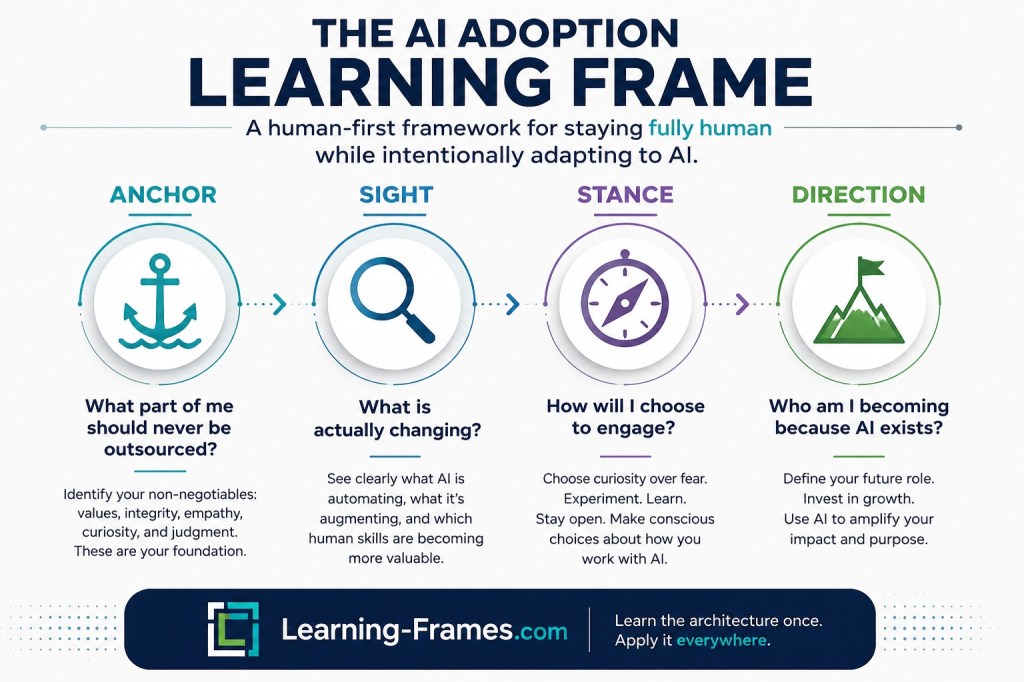
The first three parts of the frame prepare us for it.
Anchor asks what part of us should never be outsourced.
Sight asks what is actually changing, including the changes happening inside us.
Stance asks how we will intentionally engage with AI.
Then comes Direction.
Where are we going?
Who are we becoming?
Those questions move us beyond adaptation as survival.
They turn adaptation into authorship.
Instead of simply asking which parts of my job AI might take, I can ask:
What might AI allow me to become?
Instead of asking which of my skills are becoming obsolete:
What should I begin learning now?
Instead of protecting an identity built around yesterday’s work:
What experiences, strengths, relationships, and values do I want to carry into whatever comes next?
Direction doesn’t require us to know exactly where we’re going.
Sometimes we can’t.
Pargin couldn’t have mapped his eventual career when he was in college because the map didn’t exist yet.
But he could move.
He could learn.
He could experiment.
He could become.
That may be what Direction really means during disruptive change.
Reinvention Is Not Abandonment
There is one distinction I think is especially important.
Reinvention doesn’t mean becoming whatever the market demands.
That’s why Anchor comes first in the AI Adoption Learning Frame.
There should be things we refuse to outsource.
There should be values we carry forward.
There should be parts of our identity that aren’t dependent on a job title, technology, employer, platform, or market.
Without an Anchor, reinvention can become chasing.
Every new technology appears and we run toward it.
Every new trend appears and we redefine ourselves around it.
That’s not Direction.
Direction requires movement and orientation.
The question isn’t simply:
“How do I remain economically useful?”
It’s:
“Who do I want to become as the world changes around me?”
That’s a much harder question.
It’s also a much more human one.
The Future Is Discovered
We talk about the future as though it’s somewhere waiting for us.
I’m beginning to think that’s wrong.
Much of the future will be discovered while we’re moving toward it.
AI will eliminate some possibilities and create others.
New professions will emerge.
Old professions will evolve.
People will combine skills in ways that don’t make sense today.
Someone may be preparing right now for a career that doesn’t yet exist without realizing that’s what they’re doing.
Which means our greatest advantage may not be predicting the future correctly.
It may be becoming the kind of person capable of learning our way into it.
That’s what Jason Pargin’s story ultimately represents to me.
Not a formula for career success.
Not a prediction about AI.
A reminder that we are allowed to become someone new.
More than once.
Maybe many times.
The disruption we’re experiencing doesn’t have to be the end of our professional identity.
It can become raw material for the next one.
I don’t know exactly what AI will do to my work over the next ten years.
I don’t know exactly what it will do to yours.
But I increasingly believe that the people who navigate this transition best won’t simply be those who learn the right tools or protect the right skills.
They’ll be the people willing to ask a much more difficult question:
Who am I becoming because AI exists?
And then have the courage to start moving before they know the entire answer.
Learning Frames helps people learn their way through disruptive change.
The AI Adoption Learning Frame helps people remain fully human while intentionally adapting to AI.
Each Learning Frame provides practical tools for staying grounded, thinking clearly, and moving forward when the story changes.
Learn the architecture once. Apply it everywhere.
Learning-Frames.com


