AI can make you look smarter remarkably quickly.
Give it a rough email and it can make you sound more articulate. Give it a topic you barely understand and it can produce a convincing explanation. Give it a problem and, increasingly, it can simply give you the answer.
That’s useful.
But there’s a difference between producing a better answer and becoming a better thinker.
I’ve been trying to pay more attention to that distinction in how I use AI.
Instead of asking only:
“How can AI help me get this done?”
I’m trying to also ask:
“How can AI help me become more capable of doing this?”
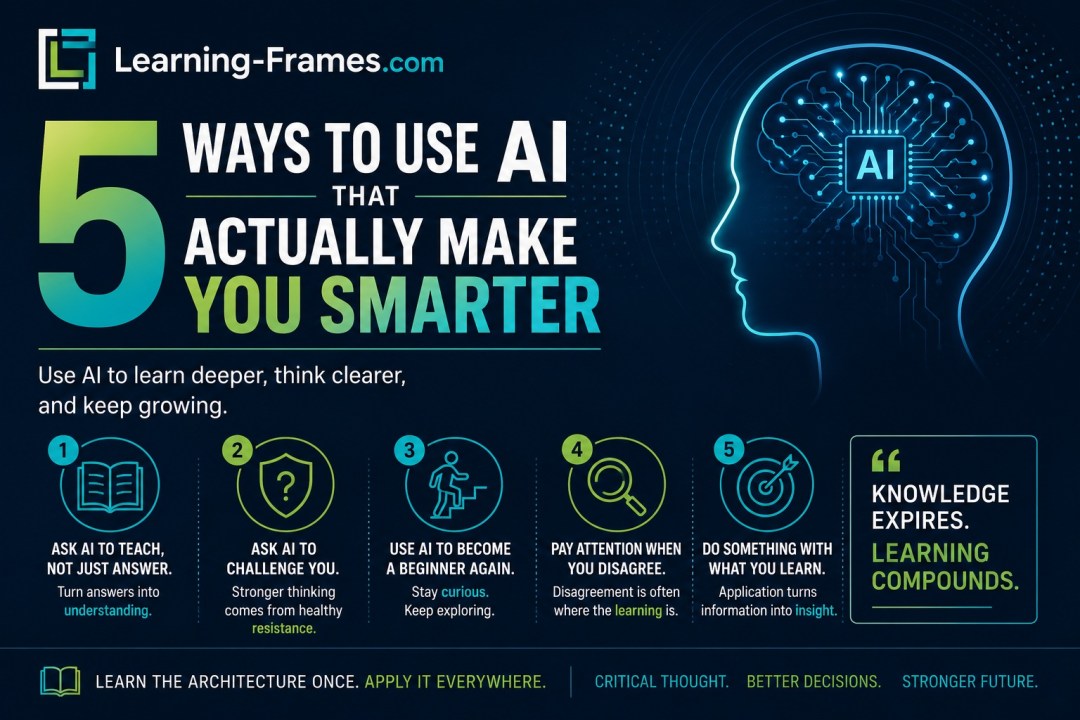
Here are five ways I’ve found to make that shift.
1. Ask AI to teach you, not just answer you
The easiest way to use AI is to ask it a question and take the answer.
Sometimes that’s exactly what we need.
But if I’m trying to learn something, I’ve started asking AI to help me understand rather than simply provide information.
Instead of:
“Explain APIs.”
I might say:
“Teach me how APIs work as if I’ll have to explain them to someone else afterward. Start simple, then increase the complexity as I understand it.”
That’s a different interaction.
I’m no longer treating AI like a search engine.
I’m treating it like a tutor.
The distinction matters because getting an answer can end curiosity.
Learning should create more of it.
2. Ask AI to challenge you
This may be one of my favorite uses of AI.
Give it something you already believe.
Then don’t ask it to improve your argument.
Ask it to attack it.
“What’s the strongest argument against my position?”
Or:
“What am I assuming that may not be true?”
Or my favorite:
“What would someone who strongly disagrees with me say I’m missing?”
Now AI isn’t replacing your thinking.
It’s creating resistance for your thinking.
That’s valuable because we naturally seek information that confirms what we already believe. AI can make that problem worse if we use it primarily to validate ourselves.
Or we can intentionally use it to do the opposite.
3. Use AI to become a beginner again
One of the greatest things about AI is that it dramatically lowers the cost of not knowing something.
There are questions we don’t ask in meetings because we think everyone else already understands.
Concepts we avoid because they seem too technical.
Subjects we’ve quietly decided we’re “not good at.”
AI doesn’t care.
You can ask the embarrassingly basic question.
Then another.
Then another.
You can say:
“I don’t understand this at all. Start at the beginning.”
There’s something liberating about that.
Expertise is valuable.
But in a world changing this quickly, the willingness to repeatedly become a beginner may be even more valuable.
4. Pay attention when you disagree with AI
I’ve started noticing something interesting.
When AI gives me an answer I disagree with, there’s a moment when I’m tempted to assume:
“It probably knows something I don’t.”
Sometimes it does.
But disagreement can be one of the most valuable learning moments AI gives us.
Instead of immediately accepting its answer, stop.
Ask:
“Why do I disagree with this?”
Then investigate.
What does the AI know that you don’t?
What do you know that isn’t represented in its answer?
What assumptions are you each making?
This is especially important because AI can sound equally confident when it’s insightful, incomplete, or wrong.
Don’t waste the disagreement.
Use it to examine your own judgment.
5. Do something with what you learned
This may be the most important one.
A great conversation with AI can feel like learning.
It isn’t necessarily.
Understanding something while AI is explaining it isn’t the same as being able to explain it yourself tomorrow.
So close the loop.
After learning something, turn AI off.
Write down what you learned.
Explain it to someone.
Make a decision using it.
Build something.
Try to teach it.
Or simply ask yourself:
“Could I explain this without AI?”
If the answer is no, you may have consumed information without actually learning it.
AI can accelerate access to knowledge.
But we still have to do the learning.
The Bigger Idea
None of these require a special model.
They don’t require an expensive subscription.
They probably won’t appear on a list of the “10 hottest AI skills.”
That’s the point.
The tools will change.
The models will change.
The prompts will change.
But the ability to remain curious, challenge assumptions, become a beginner, exercise judgment, and apply what you’ve learned will remain valuable.
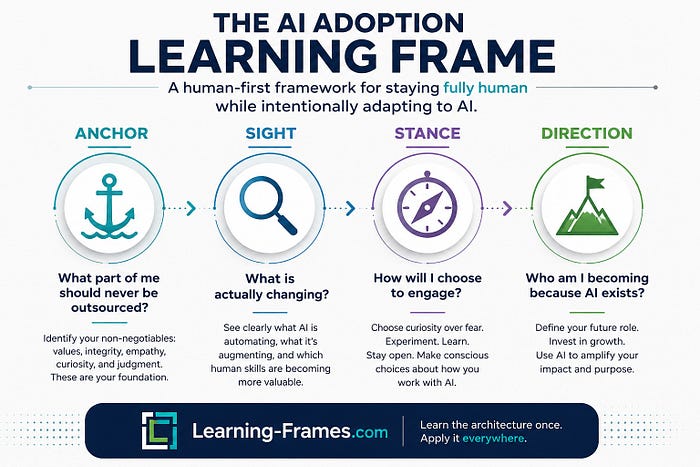
I’ve been thinking about this as Stance, the third part of my AI Adoption Learning Frame.
Stance asks:
How will I intentionally engage with AI?
For me, part of the answer is becoming clearer.
I don’t want AI simply to make me look more capable.
I want to use it to become more capable.
Because knowledge expires.
Learning compounds.
Learning Frames helps people learn their way through disruptive change.
The AI Adoption Learning Frame helps people remain fully human while intentionally adapting to AI.
Learn the architecture once. Apply it everywhere.


