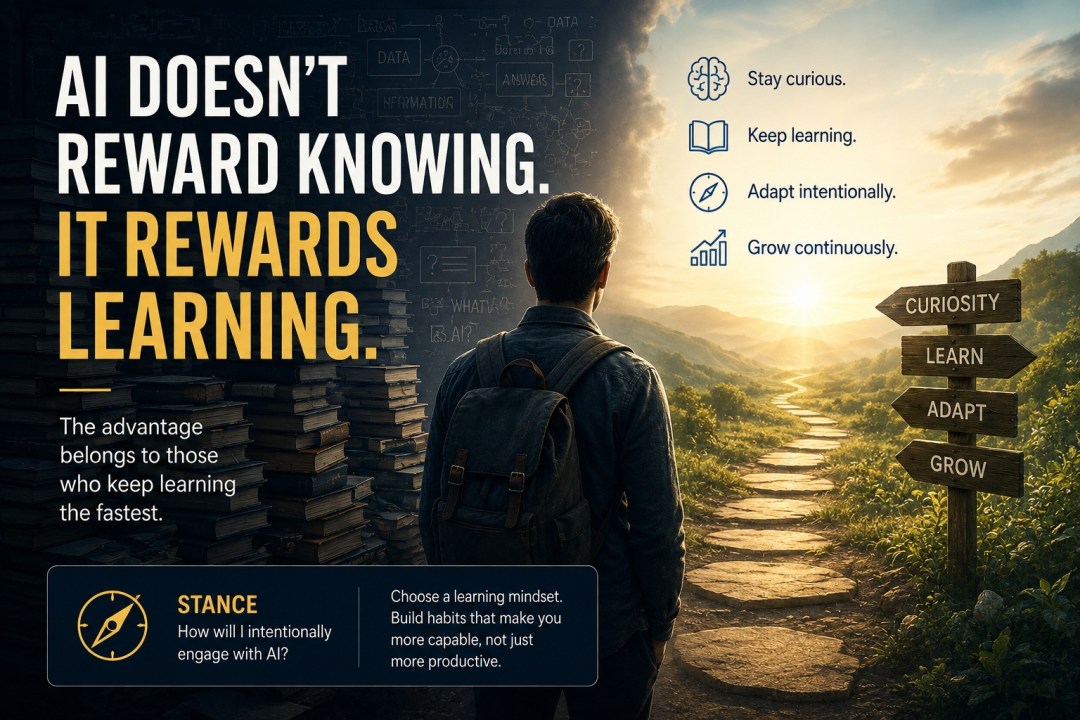
It Rewards Learning.
Every week someone asks me a version of the same question.
“What AI tools should I learn?”
“What’s the best prompt?”
“Which model should I use?”
Lately, because of my work in product management, the question is often more specific.
“What AI tools should every Product Manager know?”
They’re all reasonable questions.
In fact, I ask many of them myself.
But I’ve become convinced that they aren’t the most important questions.
I think there’s a better one.
What kind of learner do I need to become?
For most of my career, knowledge was one of the greatest professional advantages you could possess. Experience accumulated. Expertise deepened. If you stayed current in your field and continued building your skills, your value generally increased over time.
Artificial intelligence changes that equation.
Knowledge is becoming increasingly accessible. AI can summarize books, explain unfamiliar concepts, generate code, draft documents, and answer technical questions in seconds. The competitive advantage is shifting away from simply possessing information toward something much more enduring: the ability to continually learn, adapt, and apply good judgment.
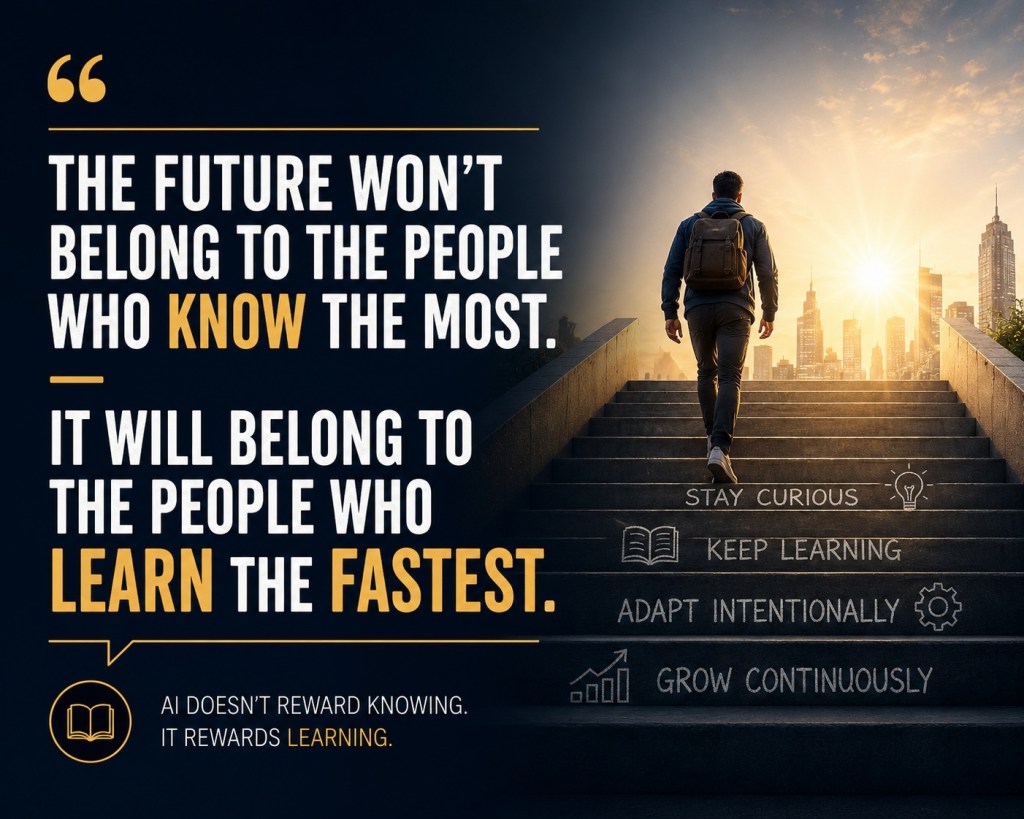
I don’t believe AI will reward the people who know the most.
I believe it will reward the people who continue learning the fastest.
That realization reminded me of research I first encountered years ago while writing Learning Frames: How to Learn From Failure. Long before generative AI existed, psychologist Carol Dweck introduced the idea of the growth mindset. Her research explored a fascinating question: Why do some people respond to challenges by becoming discouraged while others respond by becoming curious?
She discovered that the answer often lies in how people interpret difficulty.
People with what she called a fixed mindset tend to see ability as something static. Challenges become tests of intelligence. Failure becomes evidence that they simply “aren’t good at” something. When protecting your identity becomes the goal, avoiding difficult situations starts to feel like the safest strategy.
A growth mindset approaches the same experience very differently.
Difficulty isn’t proof of inability.
It’s evidence that learning is taking place.
That distinction feels more relevant today than ever before.
As AI continues changing the nature of work, I see many people approaching it with a performance mindset. They want to know the right prompt. The right certification. The right tool. The right answer. Beneath those questions is often an understandable desire to prove they can still keep up.
But I wonder if we’re pursuing the wrong goal.
What if AI isn’t asking us to prove our competence?
What if it’s inviting us to expand it?
That question reminds me of another distinction Dweck made that has stayed with me for years: performance goals versus learning goals.
People pursuing performance goals are primarily trying to validate their existing ability. They choose challenges they believe they can successfully complete because success confirms their identity.
People pursuing learning goals behave differently.
They intentionally seek experiences that stretch their abilities. They interpret setbacks as information rather than failure. Instead of asking, “Did I succeed?” they ask, “What did I learn?”
Those two mindsets produce very different futures.
One protects what you already know.
The other continually expands what you’re capable of becoming.
I believe that distinction sits at the heart of successful AI adoption.
Someone with a performance mindset might ask:
“How can AI help me look more productive?”
Someone with a learning mindset asks:
“How can AI help me become more capable?”
At first glance those questions seem similar.
They’re not.
One uses AI to protect an identity.
The other uses AI to develop one.
That difference changes everything.
Another researcher whose work has influenced my thinking is psychiatrist Judson Brewer. His research into behavior change suggests that curiosity itself can become one of our greatest tools for changing habits. Rather than fighting discomfort or avoiding uncertainty, Brewer encourages us to become genuinely interested in what we’re experiencing. Curiosity transforms resistance into exploration.
I think that’s exactly the posture AI demands.
When a new tool appears, curiosity asks:
“What can this teach me?”
When a workflow changes, curiosity asks:
“What skill should I develop next?”
When AI performs a task I once considered uniquely human, curiosity asks:
“If this is no longer where I create value, where might my value move?”
Those questions don’t eliminate uncertainty.
They transform our relationship with it.
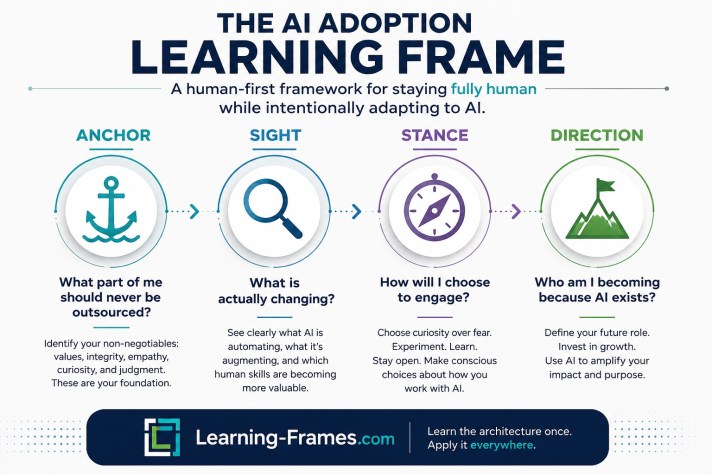
That’s why the third step in the AI Adoption Learning Frame is Stance.
Stance asks a simple question:
How will I intentionally engage with AI?
Notice the emphasis on intentionally.
Not react.
Choose.
Every one of us is developing habits around AI right now. Some habits make us more dependent. Others make us more capable. Some encourage intellectual laziness. Others challenge us to think more deeply than we did before.
The technology doesn’t make that choice for us.
We do.
For me, Stance means choosing curiosity over certainty.
It means experimenting instead of resisting.
It means asking better questions instead of searching for permanent answers.
Most importantly, it means remembering that AI is not the destination.
Learning is.
AI tools will continue to evolve. Today’s leading model will eventually be replaced. Workflows will change. Interfaces will improve. Entire categories of software may disappear.
But curiosity compounds.
The discipline of learning compounds.
The willingness to become a beginner again compounds.
Those qualities remain valuable no matter which technology comes next.
That’s why I don’t believe the future belongs to the people who memorize today’s AI tools.
I believe it belongs to the people who never stop becoming tomorrow’s learners.
Learning Frames helps people learn their way through disruptive change.
The AI Adoption Learning Frame helps people remain fully human while intentionally adapting to AI.
Each Learning Frame provides practical tools for staying grounded, thinking clearly, and moving forward when the story changes.
Learn the architecture once. Apply it everywhere.
Learning-Frames.com


