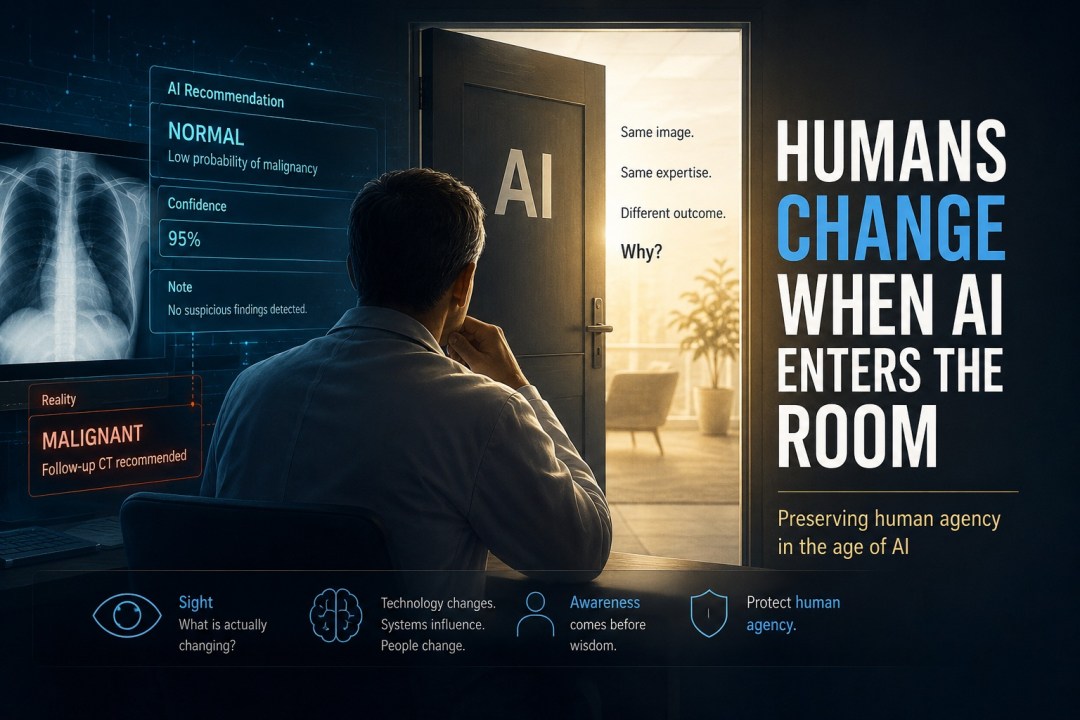
Preserving human agency in the age of AI
In 2023, researchers conducted a fascinating study involving six experienced radiologists
They asked the five radiologists to interpret the same ninety chest X-rays on four different occasions.
One session included no AI assistance.
In later sessions, the researchers intentionally gave the radiologists incorrect AI recommendations on twelve of those cases.
The results were remarkable.
When the AI incorrectly labeled a lung cancer as “normal,” the number of missed cancers increased dramatically.
When the AI incorrectly labeled healthy patients as abnormal, false positives increased just as dramatically.
Here’s what surprised me.
The radiologists had already interpreted many of these same images correctly without AI.
The AI didn’t simply produce bad advice.
It changed how experienced professionals interpreted information they already knew how to evaluate.
The radiologists didn’t lose knowledge.
They temporarily lost confidence in their own judgment.
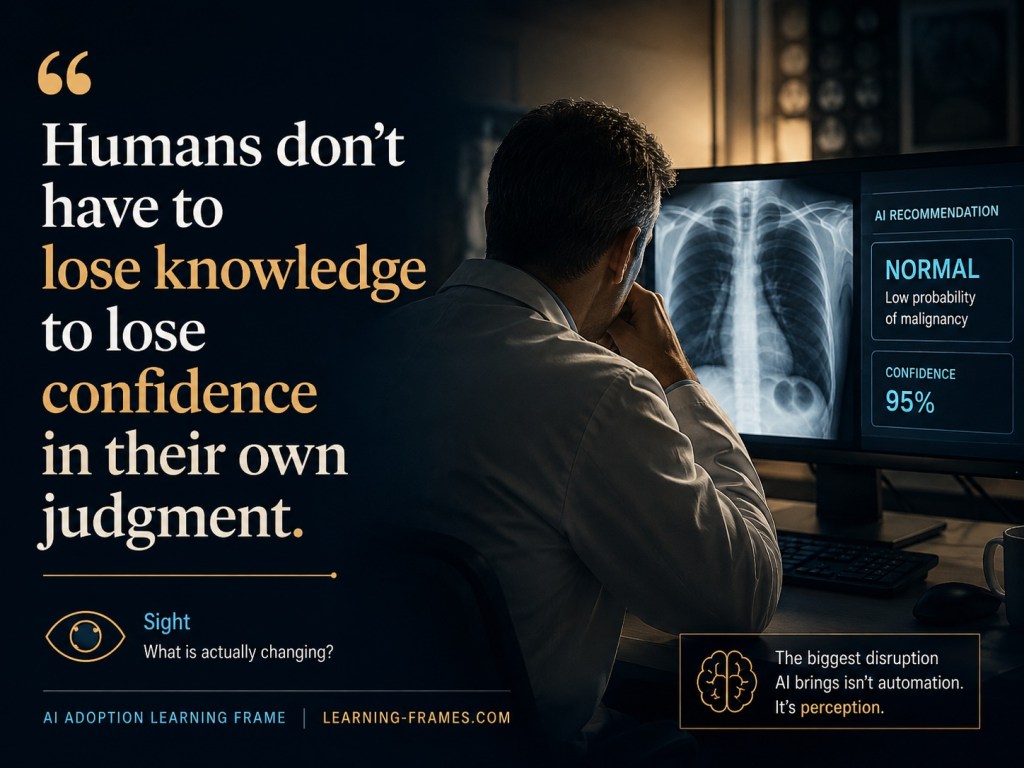
Think about that for a moment.
That isn’t just an AI problem.
It’s a human problem.
The study didn’t reveal a weakness in radiology.
It revealed something universal.
Whenever a trusted system enters the room, humans begin negotiating with their own judgment.
Sometimes that’s good.
Sometimes it’s dangerous.
Either way, it’s worth noticing.
I think we’ve been asking the wrong question.
We’ve been asking,
Can AI make mistakes?
Of course it can.
Humans make mistakes too.
The more important question is this:
What happens to human judgment when AI enters the room?
That’s a much more interesting conversation.
As I read the study, something became clear.
The radiologists didn’t suddenly become less intelligent.
They didn’t lose years of clinical training.
Their psychology changed.
Their confidence changed.
Their willingness to disagree changed.
Even more fascinating, the way the AI’s recommendation was presented changed the outcome.
When the AI highlighted the suspected area with a visual box, performance improved.
When radiologists believed the incorrect AI recommendation would remain in the patient’s permanent record, they became less willing to disagree with it.
Think about that.
The interface changed behavior.
The workflow changed confidence.
The system changed human judgment.
That’s not an algorithm problem.
That’s not an AI problem.
It’s a human factors problem.
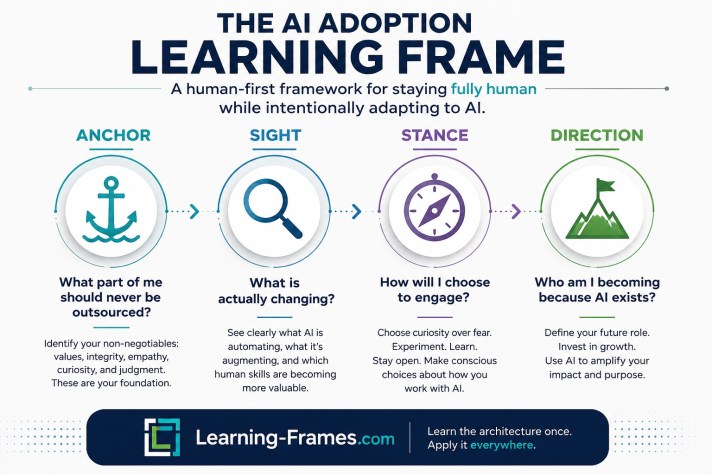
The more I thought about this study, the more I realized it perfectly illustrates the second step of the AI Adoption Learning Frame.
This is why the second step of the AI Adoption Learning Frame is called Sight.
Most people think Sight is about seeing technology clearly.
It isn’t.
It’s about seeing ourselves clearly while technology changes around us.
Sight asks one question:
What is actually changing?
At first glance, the answer seems obvious.
“The AI is changing.”
But look more carefully.
The technology wasn’t the only thing changing.
The humans were changing too.
Their attention shifted.
Their confidence shifted.
Their perception shifted.
Their willingness to challenge the machine shifted.
That’s the change we often fail to see.
I don’t think this lesson applies only to radiologists.
I think it applies to all of us.
Lawyers relying on AI-generated legal research.
Teachers reviewing AI-assisted assignments.
Developers accepting generated code without understanding it.
Students copying answers instead of wrestling with questions.
Product managers accepting AI recommendations without challenging assumptions.
Every profession is beginning to face the same challenge.
Not because AI is replacing expertise.
Because AI is quietly reshaping how expertise is exercised.
One of the greatest dangers of AI isn’t that it thinks for us.
It’s that we slowly stop noticing when we’ve stopped thinking for ourselves.
That doesn’t happen all at once.
It happens one accepted suggestion at a time.
One unquestioned recommendation at a time.
One workflow at a time.
Until eventually we begin trusting the answer more than our own understanding.
This is why Sight matters.
Sight isn’t about seeing the technology.
It’s about seeing ourselves.
It asks questions most organizations never ask.
- What is AI changing about my attention?
- What is it changing about my confidence?
- What is it changing about my willingness to question?
- What assumptions am I beginning to make because AI is in the room?
Those questions matter because awareness always comes before wisdom.
You can’t protect what you don’t notice changing.
Think about your GPS.
Have you ever followed it…
even when you knew it was wrong?
Most of us have.
Not because we stopped knowing where we were.
Because another source quietly became more authoritative than our own judgment.
AI is introducing that same psychological dynamic into knowledge work.
Radiologists.
Lawyers.
Teachers.
Developers.
Product managers.
We’re all beginning to negotiate with a second opinion that never gets tired, never hesitates, and always sounds confident.
The question isn’t whether AI is right.
The question is whether we’ve stopped noticing when we disagree.
As a product manager, I find that fascinating.
Many organizations believe they’re implementing artificial intelligence.
What they’re actually doing is redesigning human cognition.
Every interface teaches.
Every workflow influences.
Every design decision shapes human behavior.
The technology is never acting alone.
The system is.
And the people inside that system are changing too.
The biggest disruption AI brings isn’t automation.
It’s perception.
It changes what we notice.
What we trust.
What we question.
What we ignore.
And if we’re not careful, it may quietly change how we think without us ever realizing it.
Before we ask whether AI is right…
Perhaps we should ask something even more important.
Has AI quietly changed the way I’m thinking?
Because that’s what Sight was designed to reveal.
Not the limitations of artificial intelligence.
The subtle changes happening inside the person using it.
I don’t believe the future belongs to organizations that simply implement AI.
I believe it belongs to organizations that preserve human agency while they do it.
Because humans change when AI enters the room.
The question is whether we’ll notice ourselves changing too.
Citation:
Bernstein, Michael H., Michael K. Atalay, Elizabeth H. Dibble, Aaron W. P. Maxwell, Adib R. Karam, Saurabh Agarwal, Robert C. Ward, Terrance T. Healey, and Grayson L. Baird. 2023. “Can incorrect artificial intelligence (AI) results impact radiologists, and if so, what can we do about it? A multi-reader pilot study of lung cancer detection with chest radiography.” *European Radiology* 33: 8263–8269. https://doi.org/10.1007/s00330-023-09747-1
Learning Frames helps people learn their way through disruptive change.
The AI Adoption Learning Frame helps people remain fully human while intentionally adapting to AI.
Each Learning Frame provides practical tools for staying grounded, thinking clearly, and moving forward when the story changes.
Learn the architecture once. Apply it everywhere.
Learning-Frames.com

 Learning Frames