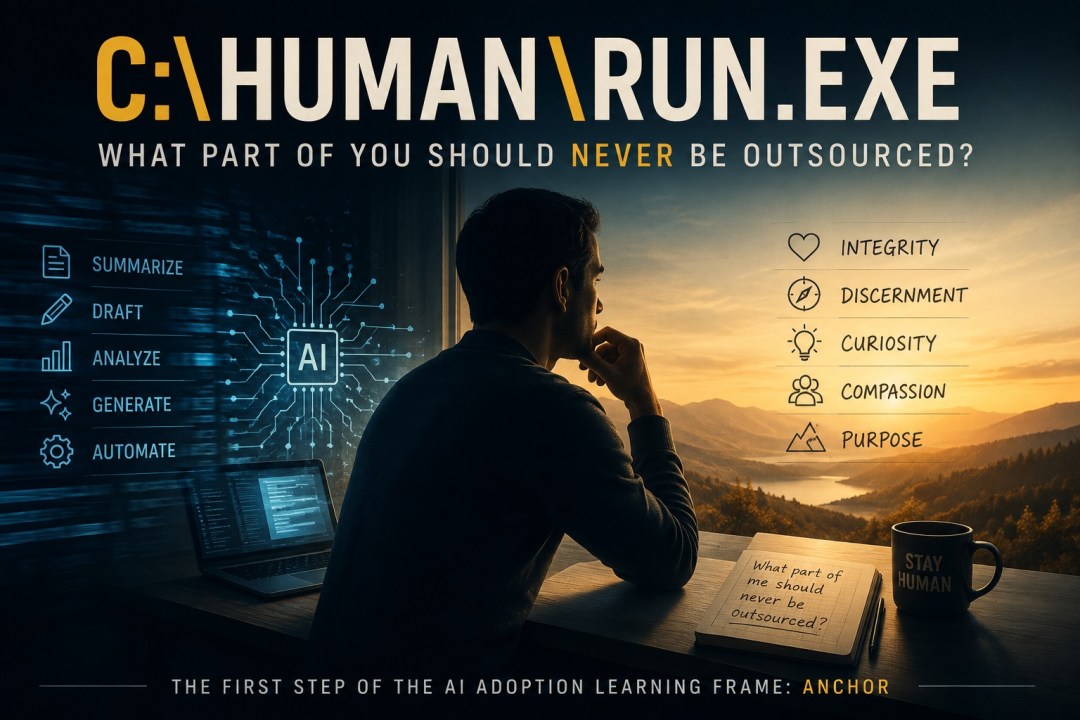
What Part of You Should Never Be Outsourced?
A college professor recently hid one word inside an exam.
Not in plain sight.
He hid it in white text so students couldn’t see it.
The word was:
Madagascar.
Students who completed the assignment themselves never saw it.
Students who copied the assignment into an AI tool and pasted the response back into their paper unknowingly included the hidden word.
Thirty-two out of thirty-five students included the word “Madagascar” In their paper/
At first, I laughed. Then I became uncomfortable.
Because the professor didn’t expose a problem with artificial intelligence.
He exposed something far more interesting. He exposed what happens when we outsource thinking without realizing we’re doing it.
And suddenly I realized…
This story isn’t really about college students.
It’s about me.
It’s about all of us.
Every day AI makes another task easier.
Writing.
Research.
Coding.
Brainstorming.
Planning.
Summarizing.
Those are remarkable capabilities.
I use AI every day.
It helps me brainstorm.
It challenges my assumptions.
Sometimes it even helps me find better words.
But every new capability quietly asks another question.
What part of ourselves are we willing to hand over?
I’ve realized that’s the question I care about most.
Not because AI is dangerous.
But because identity is precious.
As I’ve wrestled with that question, I found myself sketching what eventually became the AI Adoption Learning Frame.
Not a framework for using AI.
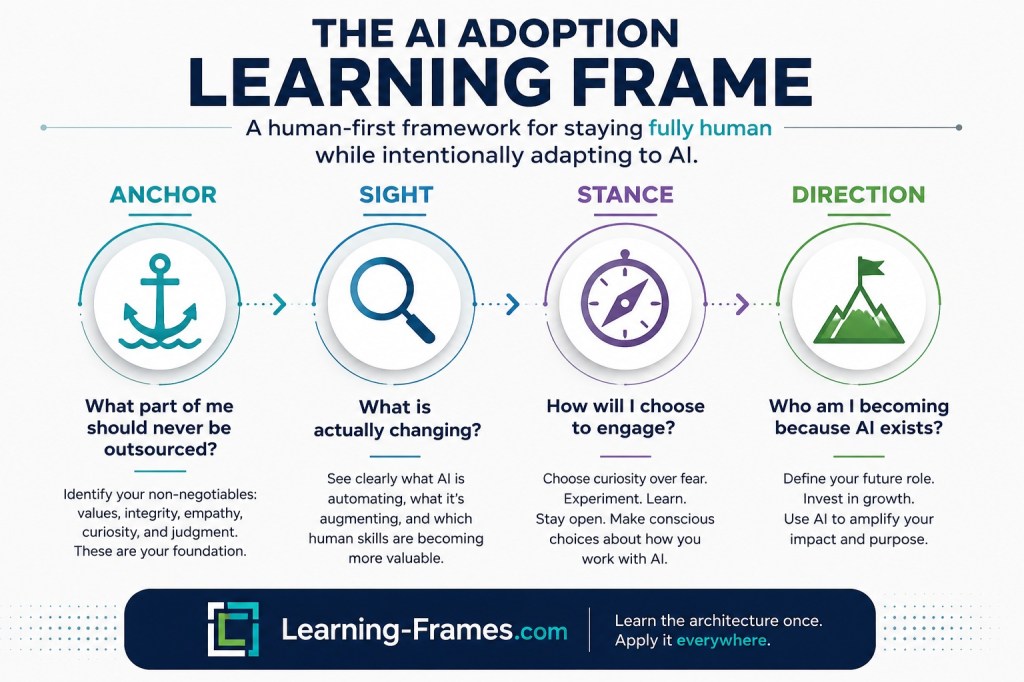
A framework for remaining fully human while intentionally adapting to AI.
The first step is called Anchor.
Anchor asks one simple question.
What part of me should never be outsourced?
When I first wrote that question, I didn’t make a list of tasks.
I made a list of qualities.
Integrity.
Curiosity.
Discernment.
Compassion.
Responsibility.
Wonder.
Conviction.
Faith.
Relationships.
Meaning.
Those are the things I never want AI to replace.
Because those aren’t outputs.
They’re character.
And character isn’t something we produce.
It’s something we become.
Even though I use AI every day, there are parts of my work I refuse to hand over.
I still wrestle with ideas.
I still edit every article.
I still ask whether the words on the page actually represent what I believe.
Because writing isn’t simply how I communicate.
It’s one of the ways I become who I’m becoming. That’s part of becoming who I am.
That’s a process no technology should replace.
When AI summarizes a difficult book…
that’s efficiency.
When I stop reading difficult books altogether…
I’ve outsourced understanding.
When AI organizes my ideas…
that’s leverage.
When I stop wrestling with those ideas myself…
I’ve outsourced growth.
When AI drafts an email…
that’s productivity.
When I stop asking whether those words reflect what I believe…
I’ve outsourced integrity.
See the pattern?
We become what we repeatedly refuse to outsource.
Character is built through repetition.
So is wisdom.
Every habit forms us.
Every shortcut shapes us.
If we repeatedly outsource our thinking…
our reflection…
our writing…
our learning…
what exactly are we becoming?
One danger of AI isn’t simply that it gives us answers.
It’s that it can create the illusion that borrowed competence is the same as developed competence.
Psychologists David Dunning and Justin Kruger observed that people often overestimate what they know because they lack enough expertise to recognize the gaps in their own understanding.
AI can make that illusion feel effortless and that can unintentionally magnify that danger.
If we’re not careful, we’ll mistake access to knowledge for understanding.
We’ll mistake fluent answers for earned wisdom.

Education has never been about collecting answers.
It has always been about becoming the kind of person capable of asking better questions.
That’s why the “Madagascar” story matters.
The professor wasn’t really testing AI.
He was testing whether his students were still participating in their own learning.
I wonder if the same question applies to the rest of us.
The first question in the AI Adoption Learning Frame isn’t,
“What can AI do?”
It’s this:
What part of me should never be outsourced?
Because AI can generate answers.
AI can organize information.
AI can imitate expertise.
But only you can build character.
Only you can cultivate wisdom.
Only you can decide who you’re becoming.
That’s why the first step in the AI Adoption Learning Frame isn’t about technology.
It’s about identity.
The answer to that one question may determine whether AI becomes one of the greatest tools humanity has ever created…
…or one of the greatest excuses we’ve ever had to stop becoming fully human.
Learning Frames helps people learn their way through disruptive change.
Each Learning Frame provides practical tools for staying grounded, thinking clearly, and moving forward when the story changes.
Learn the architecture once. Apply it everywhere.
Learn more at Learning-Frames.com


