
AI Didn’t Change My Job. It Changed What My Job Is.
When I first started using AI, I thought the biggest question was whether it would change my job.
I was asking the wrong question.
AI didn’t change my job.
It changed what my job is.
For most of my career, a significant part of my work involved gathering information, analyzing it, writing documents, creating presentations, and communicating ideas. Those activities required experience, but they also required hours of effort.
Today, many of those same tasks take minutes.
AI summarizes research.
Drafts documents.
Organizes meetings.
Generates code.
Creates images.
Challenges assumptions.
It has become part of my daily workflow.
At first, I thought this was a story about productivity.
Now I think it’s a story about identity.
Because once AI begins doing work you used to associate with your value, you’re forced to ask a much deeper question.
What is my work now?
That may be one of the most important workplace questions of the next decade.
Analysts estimate that AI will significantly reshape the tasks inside roughly six out of ten jobs over the next several years—not by eliminating most of those roles, but by quietly rewriting what “work” means within them.
That means the biggest challenge isn’t simply learning new technology.
It’s learning who we are when the work around us changes.
The easiest response is fear.
Will AI replace me?
Will my experience still matter?
Will there still be a place for people like me?
Those are understandable questions.
I asked them too.
But over time I realized I was asking the wrong question.
The better question isn’t:
Can AI do my job?
It’s this:
What parts of my job were never supposed to define my value in the first place?
That realization changed everything.
I didn’t need another AI tool.
I needed a better way to think.
That’s when I began building what I now call the AI Adoption Learning Frame.
Not a framework for using AI.
A framework for remaining fully human while intentionally adapting to AI.
It doesn’t begin with technology.
It begins with us.
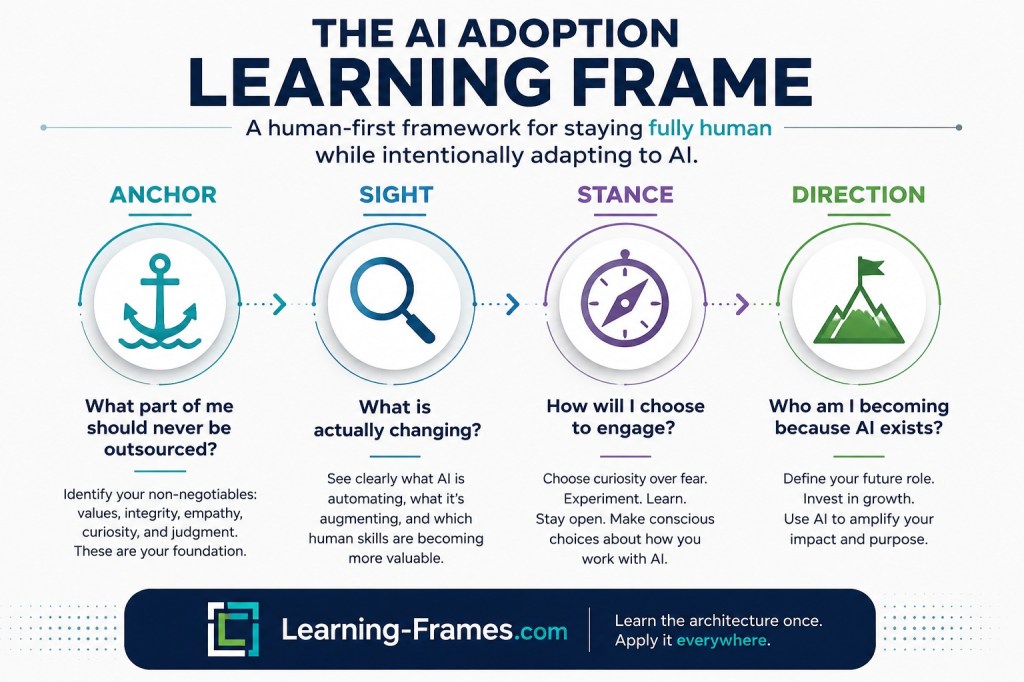
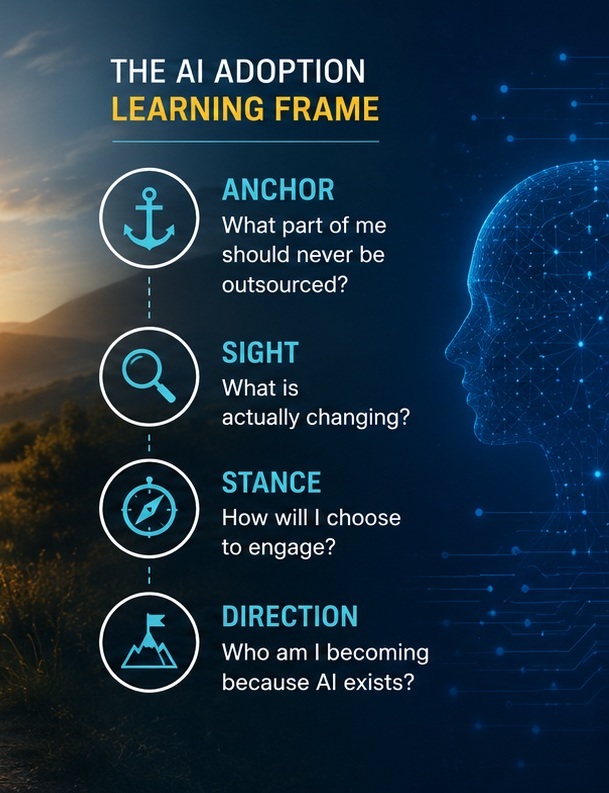
The AI Adoption Learning Frame
Anchor
What part of me should never be outsourced?
Before we ask what AI can do, we should ask what it never should do.
Our integrity.
Our compassion.
Our curiosity.
Our responsibility.
Our moral judgment.
AI can generate options.
Only humans can decide what is worth pursuing.
For most of us, AI won’t arrive as a pink slip.
It will arrive as a quiet rewrite of our job description.
The tools will increasingly handle drafting, summarizing, formatting, and searching.
Our value moves upstream.
Toward judgment.
Toward wisdom.
Toward the decisions only people can make.
When the tasks change, our identity becomes even more important.
Sight
What is actually changing?
Headlines tell us AI is replacing jobs.
Reality is more nuanced.
For an estimated majority of workers, AI won’t replace the role.
It will replace pieces of the role.
The commodity work increasingly belongs to the machine.
The interpretive work moves closer to the human.
Writing first drafts.
Finding information.
Summarizing meetings.
Generating code.
Creating images.
These activities are becoming faster and more accessible.
That doesn’t make humans less valuable.
It changes where our value lives.
The skills increasing in value are different.
Judgment.
Discernment.
Context.
Leadership.
Systems thinking.
Creativity.
Empathy.
In other words…
As AI becomes better at doing the work, it forces us to become better at deciding what the work is for.
Stance
How will I choose to engage?
Every major technological shift invites a decision.
Some people panic.
Some ignore it.
Some chase every new tool.
None of those responses are particularly helpful.
I’d rather stay curious.
Not curiosity as a personality trait.
Curiosity as a discipline.
The people creating extraordinary value with AI aren’t necessarily the most technical.
They’re the ones willing to experiment.
To ask,
“What happens if I try this?”
Then ask it again tomorrow.
They’re learning where AI accelerates their work.
They’re also learning where human judgment still matters.
That’s the habit I want to develop.
Not because AI demands it.
Because growth demands it.
Direction
Who am I becoming because AI exists?
This may be the most important question of all.
I don’t want AI to make me faster at doing yesterday’s work.
I want it to free me for tomorrow’s work.
Teaching.
Mentoring.
Connecting ideas.
Helping people learn.
Making better decisions.
Guiding others through uncertainty.
If AI is going to rewrite my job anyway, I want to participate in that rewrite.
I want to decide which parts become machine-assisted…
…and which parts become more deeply human.
Because that’s where I believe the future of meaningful work lives.
Most AI conversations focus on tools.
Which model?
Which prompt?
Which workflow?
Which platform?
Those are useful questions.
They’re just not the first questions.
The first question is:
Who do I become while all of that is changing?
I believe that’s the conversation we’ve been missing.
The goal isn’t to compete with AI.
The goal is to become more deeply human because AI exists.
For the majority of us whose jobs will be modified rather than eliminated, that means treating curiosity as a discipline and identity as an anchor.
Let AI change the tasks.
You decide what the work is really for.
AI didn’t change my job.
It changed what my job is.
And in doing so, it reminded me that work was never ultimately about what I produce.
It has always been about who I become while I’m doing it.
Learning Frames helps people learn their way through disruptive change.
Each Learning Frame provides practical tools for staying grounded, thinking clearly, and moving forward when the story changes.
Learn the architecture once. Apply it everywhere.
Learn more at https://learning-frames.com


