Why Emotions Need Frameworks Too
Summer is road trip season.
Families are loading up SUVs, stopping for gas station snacks, and heading toward beaches, mountains, and national parks. Highways are crowded. Tempers are short. And before long, someone cuts you off.
Maybe they merge into your lane without signaling.
Maybe they tailgate you.
Maybe they speed around you, only to stop at the same red light thirty seconds later.
If you’re like most people, you’ve probably felt that moment—that instant when your emotions want to take the wheel.
You’re not alone.
Nearly 80% of U.S. drivers admit they’ve expressed anger, aggression, or road rage behind the wheel at least once in the past year.
Most of those moments never become accidents.
But they reveal something important.
Stress can override judgment far faster than we’d like to admit.
And that’s what road rage is really about.
It’s not traffic.
It’s not the other driver.
It’s what happens when our first reaction outruns our best judgment.
Over the years, I’ve become fascinated by that gap.
The space between what happens to us…
…and what we choose to do next.
When I was younger, I probably justified my reactions.
“That guy’s an idiot.”
“Doesn’t anyone know how to drive anymore?”
The other driver became the problem.
Eventually I realized something uncomfortable.
The other driver wasn’t controlling my behavior.
I was handing them the keys.
That realization changed more than the way I drove.
It changed the way I thought about leadership.
Every one of us encounters situations that invite an emotional reaction.
A harsh email.
A missed deadline.
A critical comment on social media.
A coworker who takes credit for your work.
A family disagreement.
A political debate.
The circumstances change.
The psychology doesn’t.
Our first instinct is often to react.
Our better choice is to respond.
The problem is that good decisions become harder when emotions arrive first.
That’s why I’ve come to appreciate frameworks.
Years ago, I developed a simple reminder for myself during those moments.
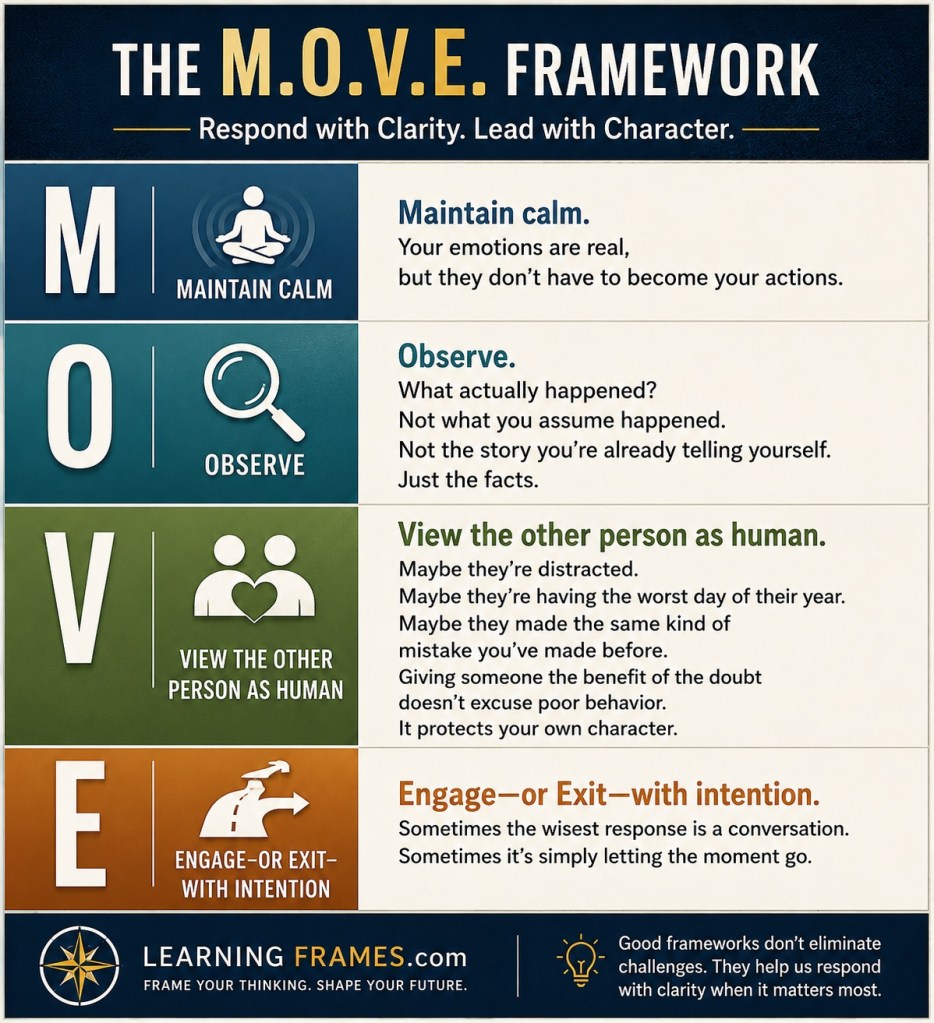
I call it M.O.V.E.
Maintain calm.
Your emotions are real, but they don’t have to become your actions.
Observe.
What actually happened?
Not what you assume happened.
Not the story you’re already telling yourself.
Just the facts.
View the other person as human.
Maybe they’re distracted.
Maybe they’re having the worst day of their year.
Maybe they made the same kind of mistake you’ve made before.
Giving someone the benefit of the doubt doesn’t excuse poor behavior.
It protects your own character.
Engage—or Exit—with intention.
Sometimes the wisest response is a conversation.
Sometimes it’s simply letting the moment go.
Not every battle deserves your attention.
I’ve discovered that this framework has very little to do with driving.
It shows up everywhere.
The best leaders don’t send angry emails.
The best parents don’t discipline from frustration.
The best product managers don’t panic when the roadmap changes.
The best teams don’t make important decisions at the emotional peak of a crisis.
They create space.
That space is where wisdom lives.
Last week I wrote about the STOP framework used in wilderness survival.
Its purpose is simple.
Interrupt panic before panic makes your decisions.
This week I’ve been thinking about a different kind of survival.
Not surviving the wilderness.
Surviving ourselves.
Because if panic is one enemy…
Impulse is another.
Both convince us that immediate action is the same thing as wise action.
It rarely is.
I’ve spent much of my career building products, leading teams, and trying to understand how people learn through change.
One lesson continues to surface.
The people I admire most aren’t the ones who never experience frustration.
They’re the ones who have practiced what they’ll do before frustration arrives.
That’s what a framework really is.
It’s pre-deciding how you’ll think when clear thinking becomes difficult.
That’s why pilots use checklists.
Emergency departments use triage protocols.
Firefighters train repeatedly before they ever enter a burning building.
They’re not preparing because they expect failure.
They’re preparing because stress changes the way humans think.
Leadership works the same way.
I don’t know what challenge you’ll face this week.
It probably won’t involve road rage.
But it may involve disappointment.
Conflict.
Unexpected change.
Or a conversation you weren’t planning to have.
When that moment arrives, your first reaction will show you how you feel.
Your second response will show who you are.
The difference between those two moments is where leadership begins.
I’ve become convinced that we spend far too much time preparing for events and not nearly enough time preparing for our response to them.
That’s one reason I continue building Learning Frames.
Not because they predict the future.
Because they help us become the kind of people who can meet the future with clarity rather than impulse.
The road will always have difficult drivers.
Life will always have difficult moments.
The question isn’t whether you’ll encounter them.
The question is whether you’ve already decided who you’ll be when you do.
Reflection
Think about the last time someone tested your patience.
What happened?
More importantly…
What framework guided your response?
Or did your emotions drive the conversation?
My mission is simple: to help people learn their way through disruptive change by building the mental, emotional, and spiritual frameworks that keep them grounded when the story changes.
Learn more at https://learning-frames.com


