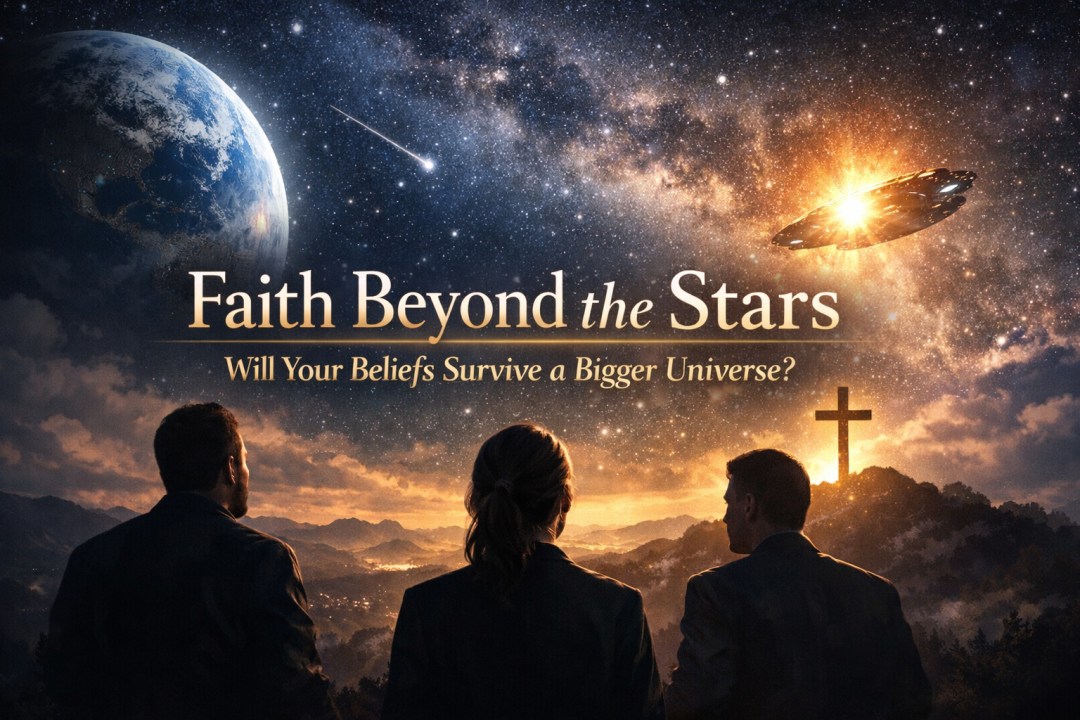
Every great alien movie or book asks the same questions.
Are they friendly?
Are they hostile?
How advanced are they?
Can humanity survive first contact?
Those questions make for entertaining stories.
But I think they miss the most interesting question of all.
What happens if they’re right?
Not right about faster-than-light travel.
Not right about physics.
Right about us.
Imagine that tomorrow the world’s governments held a press conference unlike anything in history.
They announce that intelligent extraterrestrial life exists.
Then they make one more statement.
“Humanity’s understanding of its own origins is incomplete.”
Whether you believe that scenario is possible isn’t really the point.
The important question is what happens next.
History suggests that our greatest disruptions don’t begin with violence.
They begin when our story about reality changes.
We’ve lived through moments like that before.
When Copernicus argued that Earth wasn’t the center of the universe, many believed faith itself was under attack.
When Darwin introduced evolution, others believed religion would disappear.
Neither prediction came true.
Our understanding of the world expanded.
Many people wrestled with the new ideas.
Some rejected them.
Others adapted.
But humanity continued moving forward.
That pattern fascinates me because it reveals something important: the greatest challenge isn’t always discovering new information. It’s deciding what to do with it.
Over the past few years, I’ve spent a surprising amount of time thinking about that question while writing the Disclosure Day series.
Ironically, I eventually realized I wasn’t really writing about aliens.
I was writing about adaptation.
The extraterrestrial story simply became a thought experiment that allowed me to ask larger questions.
How do people respond when certainty disappears?
How do institutions react when familiar explanations stop working?
What happens to faith, leadership, and identity when the old story no longer explains the present?
Those questions matter whether we’re talking about extraterrestrial contact, artificial intelligence, a pandemic, political upheaval, or a personal crisis.
Reality changes.
Our challenge is learning how to change with it—without losing ourselves.
That realization eventually led me to write Interview Five, Faith Beyond Disclosure, which asks a question I rarely see explored in science fiction.
Not whether humanity could survive contact.
But whether our deepest beliefs are fragile… or resilient.
Could faith survive?
Could purpose survive?
Could meaning survive?
I think they can.
History suggests they often do.
The real question isn’t whether new discoveries will arrive.
They always do.
The question is whether we’ve built lives capable of absorbing new truth without surrendering our humanity.
Perhaps that’s the one question alien movies almost never ask.
And perhaps it’s the one worth asking now.
If this kind of thought experiment interests you, you’ll probably enjoy my new book, Disclosure Day: The Interview Collection. Interview Five explores these questions through fiction, while my podcast, The Day After Signal, explores the same ideas through the lens of leadership, learning, and resilience. Together they ask a simple question: What happens when the story changes—and how do we learn our way through it?


