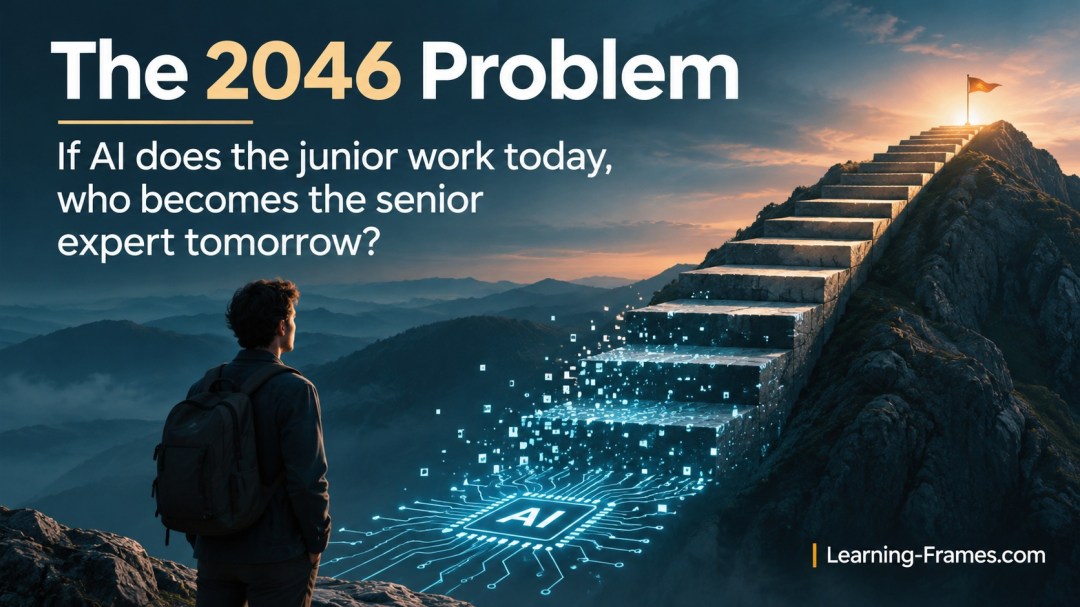
If AI does the junior work today, who becomes the senior expert tomorrow?
There is an assumption buried inside many conversations about AI and work.
It goes something like this:
If AI can perform more entry-level work, organizations will become more productive.
That may be true. AI can already help with research, analysis, drafting, coding, documentation, and many of the routine tasks that traditionally consumed a large amount of junior employees’ time. For experienced professionals, the opportunity is obvious.
A senior product manager can use AI to analyze customer feedback faster.
A lawyer can draft arguments more efficiently.
A physician can use AI to surface possible diagnoses.
A mechanic can use AI to narrow potential causes of a problem.
An experienced professional brings something important to those outputs.
Judgment.
They know when the recommendation does not make sense. They know what context is missing. They know when a seemingly reasonable answer could create a larger problem. That judgment did not appear when they became senior. It developed over years.
And that creates a problem I think we are not talking about enough.
If AI does the junior work today, who becomes the senior expert in 2046?
That is the 2046 problem.
Expertise does not appear automatically
We often talk about expertise as though it is something people accumulate simply by staying in a profession long enough. But twenty years of employment does not automatically create twenty years of wisdom. Expertise is built through experience:
Through making decisions.
Through being wrong.
Through correction.
Through feedback.
Through recognizing patterns.
Through taking on progressively harder problems.
Through seeing the consequences of decisions that looked reasonable at the time.
A junior lawyer does not become senior simply by reading more law. A physician does not develop clinical judgment solely by memorizing more medical knowledge. A product manager does not learn product judgment by studying frameworks. A mechanic does not become experienced by reading repair manuals. They become experts because they repeatedly encounter real problems, make judgments, receive feedback, and adjust.
For generations, much of that learning happened through work. The entry-level task was not only producing an output. It was also an apprenticeship. And AI may be quietly changing that.
The disappearing first rung
Consider what entry-level knowledge work often looks like.
Research.
Drafting.
Analysis.
Summarizing.
Preparing recommendations.
Reviewing documents.
Building presentations.
Comparing options.
Much of this is precisely the kind of work AI is becoming increasingly capable of performing. From a productivity perspective, automating some of it makes perfect sense. Why ask someone to spend eight hours producing an initial analysis when AI can create a useful draft in minutes? But the eight hours were not necessarily wasted. During those eight hours, the junior employee may have been learning:
They were deciding what information mattered.
They were encountering exceptions.
They were discovering where their assumptions were wrong.
They were learning what a senior colleague would challenge.
They were beginning to recognize patterns.
The output may have been inefficient. The learning may have been invaluable.
That creates a paradox.
We could make organizations much more productive today while making it harder to develop the experts those organizations will need tomorrow.
We do not know what AI will be in 2046
There is an obvious counterargument.
Perhaps none of this matters. Maybe by 2046, AI will possess judgment equal to or better than the most experienced professionals alive today. That is possible. I do not know. Neither does anyone else.
So I think we should consider several possibilities.
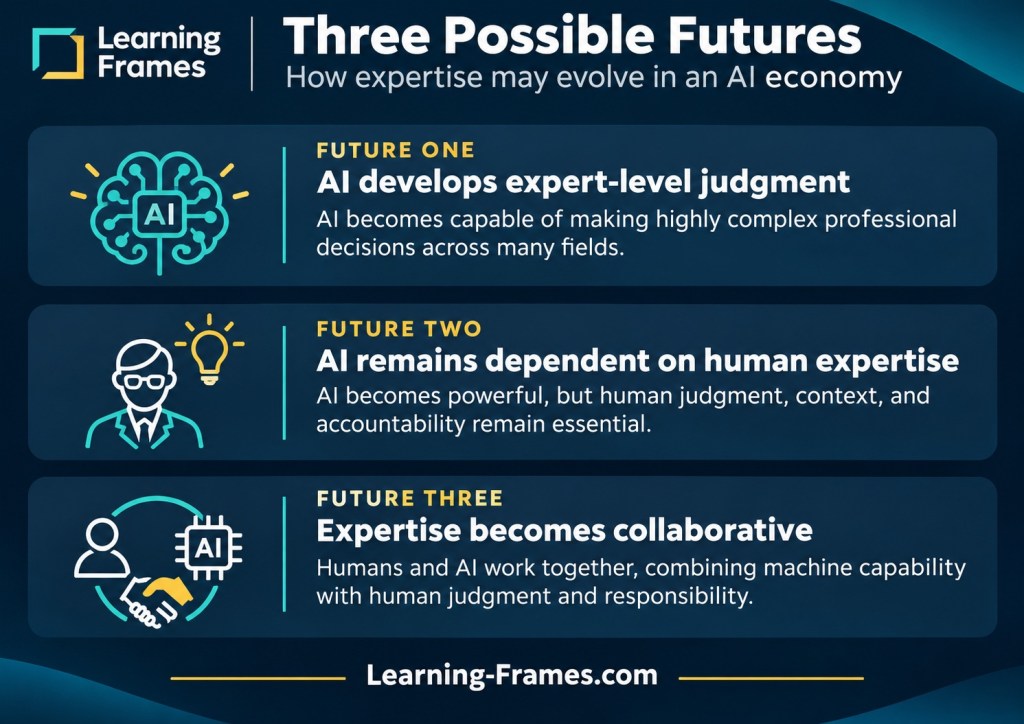
Future one: AI develops expert-level judgment
AI becomes capable of making highly complex professional decisions across law, medicine, finance, engineering, product management, and other fields.
Human expertise may still matter for accountability, relationships, governance, ethics, and deciding what outcomes are actually desirable. But much of what we currently think of as professional judgment may increasingly reside in machines.
Future two: AI remains dependent on human expertise
AI becomes extremely capable at performing knowledge work but remains weaker in areas involving context, ambiguity, accountability, competing values, and complex human systems.
In that future, experienced professionals remain essential. But organizations that eliminated their apprenticeship pathways may discover something uncomfortable:
They no longer have enough people capable of supplying the judgment the AI still needs.
Future three: expertise becomes collaborative
Perhaps the most likely future is not humans or AI.
It is humans with AI.
Machines become exceptionally good at some forms of reasoning and production. Humans retain responsibility for context, judgment, relationships, accountability, and deciding what matters. Professional expertise changes dramatically.
But it does not disappear.
These are not predictions.
They are scenarios.
And I think there is a strategic conclusion that holds across all three.
It is dangerous to dismantle the pathways through which humans develop expertise before we understand what will replace them.
The goal is not to preserve inefficient work
This is where I want to be careful.
I am not arguing that we should preserve every entry-level task simply because someone once learned from doing it. Some work is repetitive without being particularly educational. Some apprenticeship models were never very good. Some junior employees spent enormous amounts of time producing work with little feedback, little mentorship, and little understanding of why the work mattered.
We should not romanticize inefficiency.
The question is not:
How do we preserve the old work?
The better question is:
How do we preserve what the work was teaching?
That distinction matters.
AI can replace the task without replacing the need to learn what the task teaches.
And that may create an opportunity to design something better.
AI Cognitive Apprenticeship
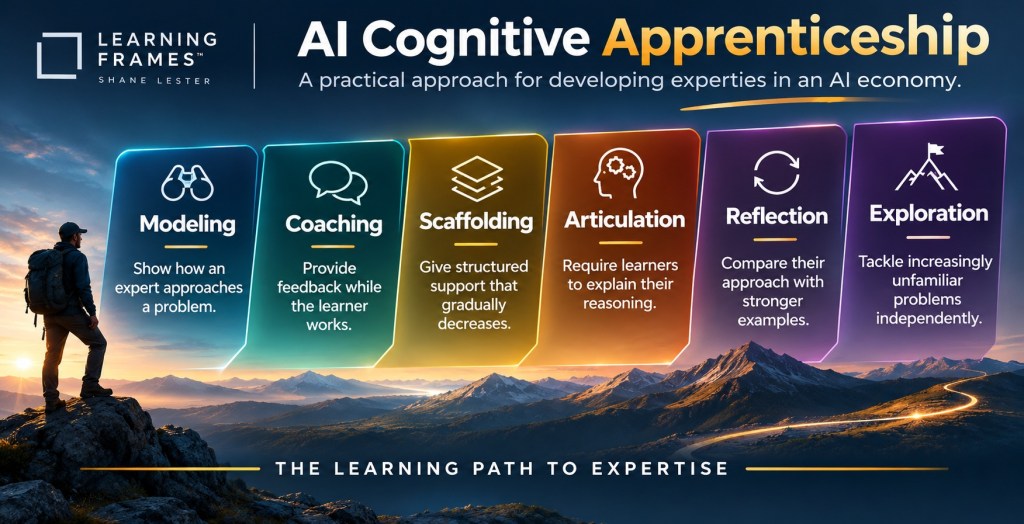
Years before generative AI, researchers Allan Collins, John Seely Brown, and Susan Newman developed the idea of cognitive apprenticeship.
Traditional apprenticeship makes physical skills visible.
A novice watches an expert.
Then practices.
Receives feedback.
Gets help.
Gradually takes on more responsibility.
Cognitive apprenticeship applies that same idea to thinking.
It emphasizes several methods:
Modeling — showing how an expert approaches a problem.
Coaching — providing feedback while the learner works.
Scaffolding — giving structured support that gradually decreases.
Articulation — requiring learners to explain their reasoning.
Reflection — comparing their approach with stronger examples.
Exploration — tackling increasingly unfamiliar problems independently.
That framework may become incredibly important in an AI economy.
Because instead of using AI simply to perform junior work, we could deliberately use AI to help people learn the thinking behind that work.
Imagine two junior analysts
Give two new analysts the same assignment.
They need to analyze customer research and recommend which product problem the team should solve next.
The first analyst prompts AI:
“Analyze this research and give me the top three product opportunities.”
The AI produces a polished answer.
The analyst lightly edits it and sends it to the team.
The work is completed quickly.
But what did the analyst learn?
Now consider the second analyst.
Before seeing AI’s answer, they identify what they believe are the important patterns.
They explain why.
AI challenges their assumptions.
It identifies evidence they overlooked.
It provides alternative interpretations.
The analyst evaluates those alternatives.
They explain which recommendation they support and why.
A senior product leader reviews the decision and provides feedback.
The analyst revises the recommendation.
The same technology is involved.
But these are very different learning experiences.
In the first case, AI completes the work.
In the second, AI helps create an apprenticeship.
That distinction may determine whether AI makes the next generation of professionals more capable or simply more dependent.
AI should not expose “the answer”
There is an important caution here.
It is tempting to imagine AI as a perfect senior colleague that can simply reveal how an expert thinks.
It cannot.
An AI-generated explanation is not necessarily a faithful representation of how the system internally arrived at an answer.
That means a good AI apprenticeship should not be built around blindly observing AI “reasoning.”
It should be built around things we can evaluate.
Worked examples.
Explicit assumptions.
Alternative approaches.
Verifiable sources.
Questions.
Feedback.
Comparison.
Reflection.
And, importantly, qualified human oversight.
AI can support apprenticeship.
It should not automatically become the authority responsible for deciding whether someone has developed professional judgment.
The AI Adoption Learning Frame gives us a way to think about this
This problem fits naturally inside the AI Adoption Learning Frame I have been developing.
Anchor asks: What must remain human?
In apprenticeship, that might include responsibility, judgment, accountability, curiosity, and ownership of learning.
Sight asks: What is actually changing?
We need to notice that AI is not only changing tasks.
It is changing the pathways through which people traditionally developed expertise.
Stance asks: How will we intentionally engage with AI?
Do we use it simply to remove work?
Or do we design workflows where AI models, coaches, scaffolds, challenges, and helps people reflect?
Direction asks: Who are we becoming?
Are we developing professionals capable of independent judgment?
Or professionals who can perform only while an AI system remains beside them?
That is not merely a technology decision.
It is a learning strategy.
Productivity and expertise are not the same thing
This may be the central tension organizations need to understand.
AI can make an experienced professional extraordinarily productive.
That does not mean AI automatically creates experienced professionals.
Those are two different problems.
Organizations understandably want productivity now. But leadership also has responsibility for capability later. Imagine an organization in 2046 that successfully automated nearly all of its junior analysis for twenty years. Then imagine that humans are still required for the hardest cases.
Where did those experienced humans come from?
Who gave them enough meaningful decisions to develop judgment?
Where did they make mistakes safely enough to learn from them?
Who corrected them?
Who helped them recognize patterns?
Who gradually increased their responsibility?
If we cannot answer those questions, we may be creating expertise debt.
And expertise debt may take much longer to repay than technical debt.
This is not just an organizational problem
It is also personal.
Anyone using AI should be asking:
Am I using this technology to eliminate the effort required to learn—or to accelerate my learning?
Those are not the same thing.
Sometimes eliminating effort is exactly what we should do.
I do not need to relearn how to format every spreadsheet.
I do not need to manually perform work that provides no meaningful learning value.
But when AI begins performing the work through which I develop judgment, I should pay attention.
Because there may be a difference between becoming more productive and becoming more capable.
The best use of AI may sometimes be to give me the answer.
Other times, it may be to make me struggle just enough to learn.
The 2046 question
I do not know whether AI will possess the wisdom of a seasoned lawyer, physician, mechanic, engineer, or product leader twenty years from now.
Perhaps it will. Perhaps human expertise will look completely different. Perhaps the distinction between human and machine expertise will matter much less than it does today. But there is something we do know.
The professionals we may need in 2046 are learning—or failing to learn—right now.
That means the question leaders should ask is not simply:
How much work can AI take off people’s hands?
It is also:
What kind of professionals are we helping them become?
If AI removes the first rung of the career ladder, we cannot simply hope people somehow arrive on the fifth rung twenty years later.
We have to build a new ladder.
And if we do it well, AI may not destroy apprenticeship.
It may give us the opportunity to reinvent it.
Learning Frames helps people learn their way through disruptive change.
The AI Adoption Learning Frame helps people remain fully human while intentionally adapting to AI.
Anchor — What must remain human?
Sight — What is actually changing?
Stance — How will we intentionally engage?
Direction — Who are we becoming?
Learn the architecture once. Apply it everywhere.
Learning-Frames.com
Measure Learning by What You Can Do Without AI.