Part 1 of the Faith After Disclosure Series
Over the past few years, conversations about unidentified aerial phenomena, government disclosures, and the possibility of non-human intelligence have moved steadily from the cultural fringe toward the mainstream. Topics that once lived mostly in late-night radio, science fiction novels, or grainy documentaries now appear in congressional hearings, major news outlets, and serious policy discussions. Whether one sees this as long-overdue transparency, strategic narrative management, or simply another cycle of public fascination, it is becoming increasingly difficult to dismiss the larger cultural shift taking place.
Most discussions about disclosure tend to focus on evidence, technology, politics, or national security. Those are important questions, and if significant discoveries are ever publicly confirmed, those conversations will matter. But I’ve found myself drawn to a different set of questions—questions that feel less scientific and more human.
What happens inside people when the story they have trusted about reality begins to change?
Not just intellectually. Personally.
What happens when a person wakes up one morning and discovers that the universe may be larger, stranger, or more inhabited than they had ever imagined? What happens when long-held assumptions about humanity’s uniqueness, origins, or place in the cosmos are suddenly challenged—not by a philosophical debate or a private thought experiment, but by a globally shared event?
For some, such a moment might feel exhilarating. For others, it might feel deeply unsettling. But regardless of where a person stands on questions of extraterrestrial life, I suspect the deepest disruption would not come from whatever appears in the sky. It would come from what happens inside the human mind—and perhaps even deeper, inside the human soul.
That may sound dramatic at first, but history suggests this is not a new pattern. Humanity has faced worldview disruption before. When Nicolaus Copernicus proposed that Earth was not the center of the universe, it challenged more than astronomy. It challenged identity. When Galileo Galilei turned his telescope toward the heavens, he revealed a cosmos far larger than most people were prepared to imagine.
Each of these moments forced humanity to reconsider its place in a much bigger story. Each created tension between established institutions and emerging discoveries. Each prompted people to wrestle with questions of meaning, purpose, and truth.
And yet, something important survived every one of those disruptions.
Meaning survived.
Community survived.
Purpose survived.
And for many people, faith survived as well—though often in forms that were deeper, more examined, and less dependent on inherited assumptions.
That historical pattern raises an interesting possibility: perhaps the greatest challenge of disclosure—if it ever comes in a meaningful and undeniable form—will not be whether humanity can process new information. Humanity has always adapted to new information.
The deeper question may be whether our identities, convictions, and spiritual frameworks are strong enough to absorb a larger reality without collapsing under its weight.
I’ve come to believe that if disclosure ever becomes real in the public imagination, the first battle will not be fought in the sky. It will be fought through interpretation.
Facts rarely arrive alone. They arrive through institutions, headlines, commentators, social media feeds, expert panels, and carefully chosen language. Information does not simply tell us what happened. It often tells us how to feel about what happened, who to trust, what to fear, and what conclusions seem socially acceptable.
In other words, facts rarely arrive alone. They usually arrive inside a frame.
They come through institutions, headlines, expert panels, social media feeds, documentaries, podcasts, and carefully chosen language. Information doesn’t simply tell us what happened. More often, it quietly shapes how we should feel about what happened, who we should trust, what we should fear, and which interpretations feel socially acceptable.
That becomes especially important during periods of disruption. Whether the trigger is a global pandemic, a sudden breakthrough in artificial intelligence, economic instability, political upheaval, or even the possibility of non-human intelligence, the pattern is often the same: the event itself creates uncertainty, but the human response is shaped by the stories that quickly form around it.
Over time, I’ve come to believe that most people do not struggle primarily because reality changes. They struggle because they lack a process for interpreting change while it is happening.
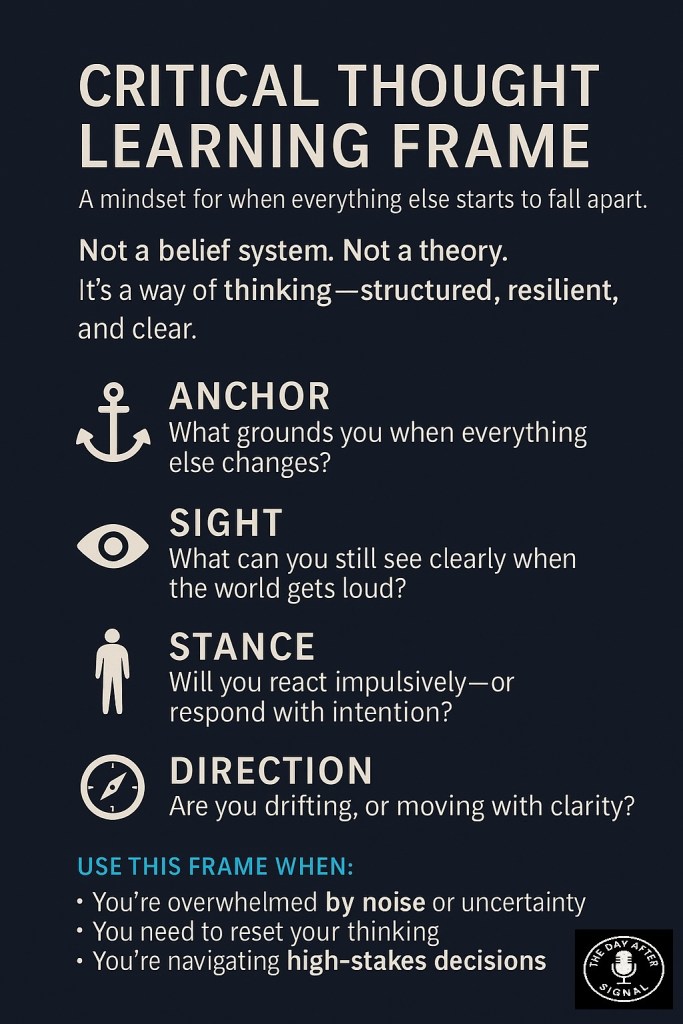
That realization is what led me to develop what I call the Learning Frame—a simple four-part process designed to help individuals stay grounded when familiar narratives begin to shift. It can be applied to personal setbacks, cultural disruption, organizational change, or extraordinary global events.
The frame begins with Anchor.
When the world becomes noisy, uncertain, or emotionally charged, what holds you steady? What principles, relationships, beliefs, or deeply examined convictions remain stable even when the headlines do not?
From there comes Sight.
What are you actually seeing? What is verified, what is assumption, and what may simply be emotional contagion disguised as certainty? Sight requires the discipline to separate signal from noise, evidence from amplification.
The third step is Stance.
Once uncertainty arrives, how will you respond? Will you react impulsively, outsource your thinking, or allow fear to dictate your posture? Or will you slow down long enough to think, observe, and respond with intention?
And finally, Direction.
Once the disruption has challenged your assumptions, where do you go from there? How do you move forward with purpose instead of drifting with the strongest narrative in the room?
I originally built this framework to help people navigate everyday uncertainty—career setbacks, leadership challenges, organizational change, family struggles, and moments of personal reinvention. But the more I study cultural disruption, the more convinced I become that the same framework applies to much larger questions.
Including this one.
If humanity ever faces a moment of undeniable disclosure, the challenge may not be simply understanding what has been revealed. In the context of extraordinary claims—whether political, scientific, spiritual, or even extraterrestrial—I believe we need more than curiosity. We need filters that help us remain open without becoming unmoored.
The deeper challenge may be learning how to remain fully human while learning to live inside a bigger story.
In future blogs, I want to explore what that might look like. I want to examine how faith responds to scale, how institutions shape public narratives, how extraordinary intelligence should be evaluated, and why spiritual resilience may matter more in the coming decades than many of us realize.
But before exploring any of that, there is a quieter and more personal question worth asking:
If the universe turns out to be far bigger than you imagined… what, exactly, in your life remains unchanged?
Because the real question may not be whether faith can survive the stars.
The real question may be whether yours can.
Coming next in the Faith After Disclosure series:
Could Advanced Beings Be Wrong?
Why Intelligence Alone Should Never Be Mistaken for Truth
More about UFO/UAP topic
Extraterrestrial Disclosure: What Happens the Day After

Disclosure Day (4 book series)

Day After Signal Podcast


